Novelty

quantum queen

Novelty by Valerie Parente

I always felt like an ongoing stream of my former self, like a passing current from the past through the current.
But lately I feel disconnected from the old moments and more connected with the sole moment.

I always felt like a blurry memory, like an irrelevant event trying to relive my intent.
But lately my memories are fleeting like separate entities separated from my identity.

I always felt like I had the right words racing in my mind, like I had to be the first person to write words in the first person.
But lately I cannot remember the word I was looking for, and I am quite content with the quiet content.

And though these new feelings leave me unsure of myself, I somehow feel more like me.
Because I might not know what I am all about, but I finally stand a fair chance at finding that out.

– Valerie Parente (8-11-16)

Shy of Me

Shy of Me by Valerie Parente

shy

“I’m shy” is not the statement it seems to be.
When I shy away from showing my personality
I masquerade myself purposely out of anxiety
so that I won’t feel disappointed by my inadequacies.
Feigning to be responsible without feeling responsibility.
It’s not about you seeing me for me and not liking what you see,
it’s about me being me before I’m sure what I mean.
Oh the horror of representing myself insufficiently!
Falling short of the ineffable me I dream.
Me being me without calculated routine
or me being me without addressing my needs.
It’s not about you judging me unfairly,
it’s about me feeling like I am incomplete.
Oh the horror of trying my best having yet to succeed
in being the most perfectly perfect version of me.
So I’ll state “I’m shy” and succumb to anxiety.
Too afraid to be imperfect, I fall shy of me.

– Valerie Parente (7-15-16)

Quest

“You don’t want to get better.”
I was extremely offended.
“You don’t want to get better.”
I was extremely offended again.
“You don’t want to get better.”
…and again. It is difficult to get over an emotion when your glitching mind replays conversations… sentences… phrases… words… sounds… again, and again.
“You don’t want to get better.”
The sting of the comment was starting to subdue into a vapid memory, naturally losing its caustic power with every mental replay.
With a clearer mind I tried to understand why I was so offended by the comment.
“You don’t want to get better.”
That can’t be true. I know I want to get better. I know OCD is not my friend. But to entertain the idea that living with OCD is living carefree would be foolishly wrong. There is no serum to permanently reverse this mental illness in its totality, but even if there was, the idea of simply ousting obsessive compulsive disorder is not a matter of “getting better” to me. But why do I view “getting better” with such a cringe-worthy connotation?
It’s not that I want OCD… it’s that… I would feel lost without OCD.
At those critical ages when a kid becomes an adult, when virtues are established, and when identity is found, the development of my personality coincided with the development of my mental illness in a symbiotic relationship.
Obsessive, compulsive, and disordered have fused themselves with the evolution of my personality, so it makes perfect sense that I would feel lost without the anxiety disorder that has pervaded my growth into adulthood.
I do want to feel better. I do not want OCD to rule my life. But I understand that to embark on a life without this mental disorder (if I were somehow endowed with OCD’s cure) would be to face a whole new challenge in itself, a challenge of feeling totally lost and having to find myself. I would need to be ready to take on that challenge. But you know what? I don’t think I get to consciously choose when I’ll be ready for that challenge. And I know this to be true because I already unintentionally started to face that challenge of self-discovery. Because to realize there is a challenge that needs to be addressed is to already begin to address that challenge. I might be lost, but I will find my way.

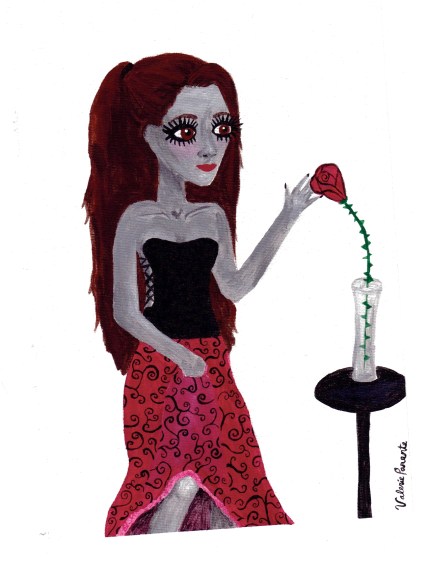
"Rose Quest"

“Rose Quest” by Valerie Parente

– Valerie Parente (7-9-16)

Hierarchy of Aversions

Some obsessive compulsive disorder sufferers are deeply disturbed or repelled by certain objects, ideas, words, feelings… anything really. Often times people with OCD tend to perform avoidance rituals, in which they obsessively and compulsively avoid these things that stir up so much fear and anxiety. In my OCD struggle with avoidance rituals I have mentally deemed these repulsive obsessions my aversions.
In trying to sufficiently explain how my aversions rise and fall from different degrees of anxiety-inducing severity I have constructed a model I like to call my Hierarchy of Aversions.

Hierarchy of Aversions
NOTE: The Hierarchy of Aversions is constructed by an obsessive compulsive designer.
This mountain of obsessions was built on an OCD premise with the least worrisome aversions at the pinnacle and the most flagrant aversions at the foundation. While most hierarchical structures are stacked with the more dominant echelons ranking at the top of the pyramid, the Hierarchy of Aversions is layered with the least bothersome aversions at its peak, where they are closer to drifting out of sight and out of mind. Unorthodox, yes, but OCD is not orthodox, nor is it logical. Remember, the Hierarchy of Aversions consists of empirical levels that draw their order from a disorder in the constructor’s mind. The primary fears are set at the bottom of the pyramid because they bolster up every other fear. The obsessions that elicit compulsions on the bottom indirectly influence every fear on top.

NOTE: The Hierarchy of Aversions is constantly under renovation.
The contents at each level of the pyramid frequently climb up and down or come and go. What gives these OCD aversions mobility in the Hierarchy of Aversions is the mood of the constructor. Stress causes the disturbing images, ideas, or rituals to weigh heavier, subscribe to gravity, and drop closer to the bottom of the aversion pileup. When moods are lighter and stress is at bay it is common for aversions that once seemed so prominent and so debilitating to feel “not so bad after all”. They, too, become lighter and rise towards the top of the hierarchy. With a little push these flagrant obsessions can even float away.

NOTE: The Hierarchy of Aversions can be manipulated!
Sometimes aversions go away on their own, without the voluntary aid of OCD recovery. When an aversion seems to effortlessly evaporate it can feel like some random blessing. In trying to understand these “random blessing” cases I’ve come to the conclusion that there’s some subconscious effort on the obsessive compulsive disorder sufferer’s part, an effort that ironically involves using OCD to defeat OCD.
For me, when fears no longer appear fearful one of the two situations has typically happened…

1. I had an amazing experience relating to that aversion.
2. I had a horrible experience relating to that aversion.
These seem like very contradictory experiences. Illogical, right? That doesn’t matter. OCD does not rely on logic!

Allow me to explain with the following examples.
1. I had an amazing experience related to an aversion.
I used to have an intense anxiety-driven disdain of the number “7”. I would actively avoid touching, looking at, or talking about anything that had “7” written on it or generally pertained to this digit. But eventually one day, on the 7th, I had an amazing experience. I do not remember what the experience was (and it does not matter). The fact is, I now had a positive connotation to attribute to the number “7”. I almost felt like I had no choice but to graduate the aversion all the way up the Hierarchy of Aversions and, without a further thought, that aversion disintegrated into thin air. Relating “7” to something bad constituted this fear as an aversion in the first place, but using that same OCD mindset I related it to whatever “good” thing happened that day and wound up eliminating the aversion.
2. I had a horrible experience relating to an aversion.
Since the Hierarchy of Aversions is a structure of varying anxiety-inducing obsessions, the very order of this model comes from relating the severity of obsessions to one another. This can actually work to the OCD sufferer’s favor, because when a less severe aversion sitting towards the top half of the Hierarchy suffices, it is much easier to quickly overcome that obsession, or at least diminish the anxiety it induces, by comparing that obsession to the more intense obsessions at the hierarchy’s base.
I actively try to avoid germs, so I do not like walking barefoot in my own home. But even more so I avoid walking barefoot in any environment outside of my home. So, in the instance that I am forced to walk across my floor barefoot because I forgot socks or shoes I get anxious, but then I remind myself that it could be worse- I could be walking across the floor of some filthy public setting. And even though the alleviation of that anxiety is temporary, it is still alleviation. And yes, I am still averted to walking on the floor barefoot, but in pair with exposure this comparison of “it could be worse” nudges that aversion up higher on the hierarchy where it is not nearly as bad as it once seemed.

These two methods I have used to graduate aversions from firm obsessions to fleeting memories involve controlling the OCD with OCD. There is no getting rid of this disease for me, just manipulating it to my advantage so that certain obsessions and fears seem less scary and become more prone to evaporating.

– Valerie Parente (6-26-16)

Her Bright Pink Shoes

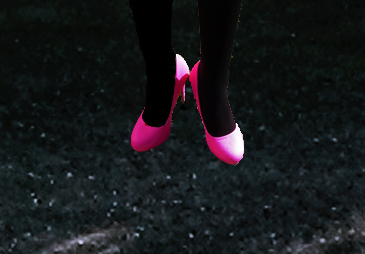
Her Bright Pink Shoes by Valerie Parente

He kept his hood on and hands lodged in the cotton confines of his pockets while maintaining a catatonic stare on the young woman’s feet. Her bright pink shoes were glaringly vibrant against the damp asphalt of the parking lot.
Sick and tired of his optical deviation away from her emotive eyes and onto her pointed toes, the impassioned girl crouched to the pavement and forced herself into his vision. “You,” his good friend affirmed, and the boy didn’t look away, “You are constantly shuffling between pain and fear. When you’re depressed, you don’t care about yourself at all. And when you’re anxious, you care so damn much about your own well-being that you worry yourself sick.”
“Why are you telling me this?” he retaliated through clenched teeth, hoping the aggression in his tone would hide his true desperation for an answer.
“Because!” having captured his full attention she leaped up and stood tall at five feet, “At some point you are going to realize that there is more to you than pain and fear,” she declared, “And you know what? That’s going to confuse the crap outta you. Because you’re not gonna know what to do with yourself.”
And in a fraction of a second, her bright pink shoes scurried away and she was gone.
And he… he didn’t know what to do with himself.

her bright pink shoes

– Valerie Parente (6-22-16)


Matter: A Symbol of the Mind

Mind generates the fear.
Matter symbolizes the fear.

Obsessive compulsive disorder likes to customize itself according to whichever person it sinks its parasitic teeth into. My list of OCD anxieties is different from another person’s list of OCD anxieties. Though the content in each OCD list might vary between person to person, the layout remains quite uniform.

In the left column we have an intangible thought (a fear of something), and in the corresponding right column we have a more palpable experience or object (that actual something).

These obsessive thoughts, which forbid or demand certain compulsions, are exponentially more anxiety evoking than physically bringing one’s self to the point of defying said-thought.
To put this notion in perspective, take general anxiety into account. A common example is the fear of public speaking. When you have anxiety about going on stage and talking to a crowd the fear building up to delivering a speech is so much worse than actually delivering the speech.

a conscience full of nonsenseNow revert this idea back to OCD. When I say I am afraid of germs it is my fear of going into a bacteria-ridden public place that causes me more distress than physically walking into the actual setting and realizing, through exposure, that, “hey, I can deal with this”. This is not to say that I do not get anxious when I think I have been contaminated by germs- trust me, I do- but is it the physical germs that are causing the anxiety or a thought itself that causes the anxiety? It is the thought. That irrational frequently occurring thought. The physical germ is just a symbol of the fear having been generated from my mind.
Fear comes from the mind, not from matter. And as much as I want to believe that there is some reasonable connection between my thoughts and the material world I cannot deny the factual evidence that my obsessive compulsive fears are what stir up anxiety, not the actual events or objects which those fears are based on.

– Valerie Parente (6-13-16)

The Gargoyle Mindset

The Gargoyle Mindset by Valerie Parente

Behold the gargoyle mindset
This is an anxiety complex
The result of an artistic process
By a paranoid architect.
A sculpture so grotesque
Created to act as a fortress
A creature against all the darkness
Featured along a flying buttress.
The gargoyle awaits upon his tier
But its purpose has begun to veer
Going from complacent to cavalier
A defense mechanism with a spear.

In the gargoyle mindset
Anxiety is placed with fret
On the outside it sits
For all to witness.
Once designed to protect
Became its own threat
A public display of stress
Notorious in all its ugliness.
Sometimes our minds equate safety with fear
And we get caught up in this superstitious idea
That to scare off the scary coming near
We have to create a scarier peer.

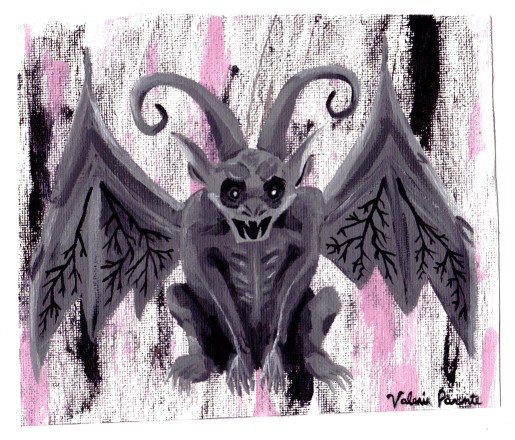
A Gargoyle Named Anxiety

“A Gargoyle Named Anxiety” by Valerie Parente

– Valerie Parente (5-22-16)