Echoes
“Your thoughts are synonymous with echoes,” he tells her.
The carefully constructed sentences, spontaneous words, even fragmented enunciation playing out in her mental script are no more or less compositions of sound waves bouncing back and forth in the maze of her mind. Echoes, reflecting off of walls that are as jagged as those doodled by this daydreaming girl who has been half-listening in class. But half of her half-listening is because the thoughts playing out in her own mental labyrinth are lingering. It is not so much a matter of volume, but of frequency. Her echoes reverberate long past the initial sound has run its course. They repeat, repeat, repeat. She can hear the echoes going on and on, cycle after cycle, aware of their questionable rationality because nobody outside of the maze walls seem to be able to hear what she hears. Not even him.
In an effort to make sense of the auditory world reflecting and bouncing inside her she measures these echoes in the same way she measures the dissonant, yet not so distant, world around her- first by participating in the world, second by dissecting the emotional content that transpires by said participation.
She sits back and listens.
The echoes conduct her. Using her instrument of a body she carries out the actions in demand. And what happens… what happens is strange. Is that… is that harmony that she hears?
The echoes that first caused so much panic were silenced upon obedience. It seems that resonating with the echoes was key in tuning them out. She makes mental note of this auditory pattern.
But what transpires when a mental note is jotted down in a mentally disordered mind?
“Your thoughts are synonymous with echoes,” he tells her.
And so on, a new echo starts. This illusory harmony was none other than noise in disguise, false harmony, proving that the only way to tune out an echo is to incite a new echo, conquer a current obsession with a new obsession. The cycle goes on. A natural frequency, the frequency she most prefers, is not the default for the unnatural maze of a mind. But she knows that she will learn to be okay with this. Because though he cannot hear her echoes, he is receptive enough to acknowledge that she can. And that is true harmony.
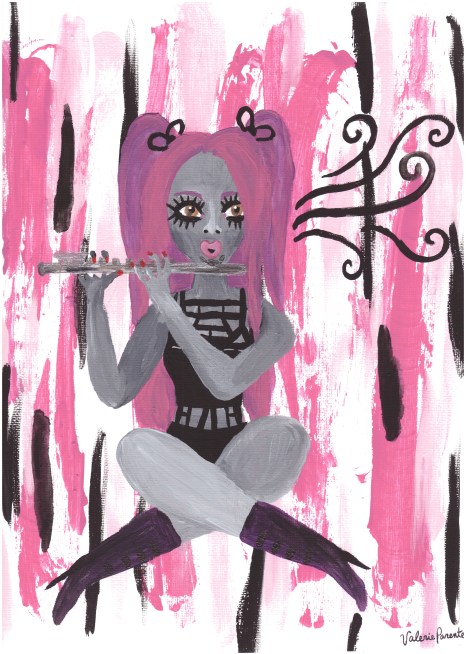
“Serenade” by Valerie Parente
– Valerie Parente (4-23-16)