It’s not a battle I should have to fight but it’s a battle I don’t mind because I know what its like to fight for my life when my own mental strife destroyed me from the inside and I was forced to find a new reason to try so if someone out of spite wants to give me a hard time about the things that kept me alive then I’m perfectly fine fighting that fight.
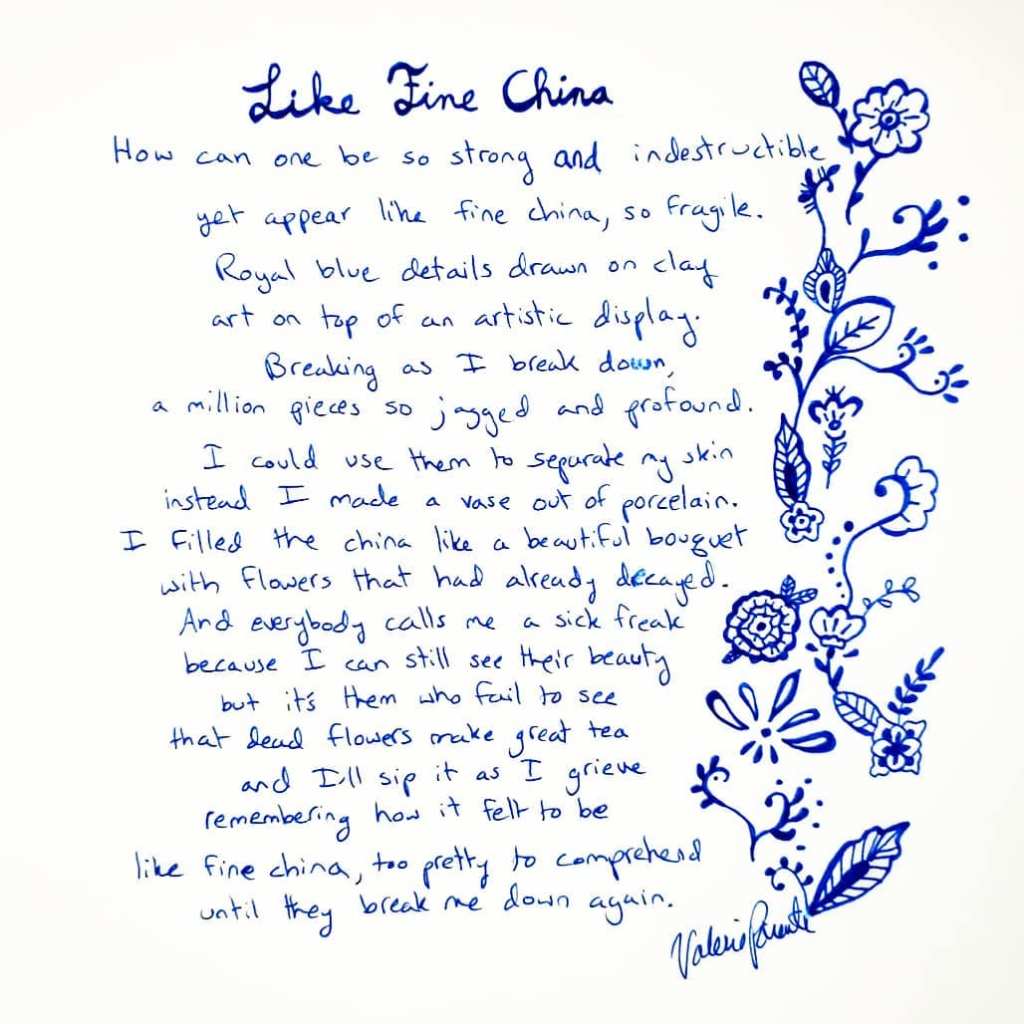
I wrote this poem, “Like Fine China“, without fully understanding what my subconscious was trying to tell me. After reading it a couple of times I realized the meaning behind the words. Fine China is the symbol for making art (something beautiful) out of sadness. The sadness is a constant cycle that manifests itself like patterns on fine China, royal “blue” (sad) details that I’ve etched upon the surface (my writing). When I have days that I break down, the porcelain breaks down, and I could use the jagged pieces of sadness to hurt myself but instead I choose to use them to build a display out of the broken pieces in the form of a porcelain vase (art from my mental breakdown) and there I show off pretty flowers (rhymes through poetry). The problem that arises from creating art out of sadness, sometimes sadness that a 3rd party might see as “old news”, is that these emotions I’ve recited are as good as dead to the world, hence why the flowers in the fine China vase I’ve built are decaying. The wonder in this, though, is that those decaying flowers offer me, the writer, solace. The cycle of sadness and creativity continues as the decaying flowers become a beautiful floral tea that I turn to for comfort as a grieve the ongoing pain I’m still in. Other people don’t see the benefit of the flowers (writing about perpetual pain), but I do. The entire process from fine china to a floral tea is cathartic, as is the artistic process, and in the end I feel okay and like I can survive my own mental state. Alas, a new day comes, the sadness inevitably returns as I am overwhelmed with reminders from the real world, and the pretty pain goes back to being “too pretty to comprehend” (commentary on not fully understanding what I was writing in the poem itself “Like Fine China”). Thus the entire breaking down of fine china (delving into an artistic outlet) occurs again.
Isn’t it incredible how art can be completely mindless but reveal something so profound in the mind it spawns from?
Do not get freaked out that everything you do seems to have a common theme. Be amazed that your subconscious understands the grand scheme. Because your mind is the universe’s method of making itself seen.
I’m really sick of the narrative that’s evolved in our society that you are forever a victim and you can never achieve autonomy, that when other people hurt you all you can do is be defeated and blame another being for the ways you’ve been mistreated.
There’s no room for healing because there’s no personal responsibility or accountability or the ability to take actions into your own hands and set yourself free because the things we teach is that owning your faults is out of reach and you can never rise above because you are just a victim and the only cure is romantic love.
Screw that toxic overdrawn narrative that tells you to point fingers and cry. You’re so scared to lose the battle that you don’t even try. And there is nothing attractive about blaming the world for your mind.
Over a decade of deep hurt frustration that became a part of me I longed for an explanation to return but I don’t care about “I’m sorry”. I realize I’m not going to be cured by someone else’s apology. I need to do the inner work to become the savior I want to be and I’m flattered by the remorse but I can’t depend on a back and forth to remind me of my self-worth when I can find solace in my own words.
Happy 2 year anniversary since I published my realistic fiction novel about obsessive compulsive disorder, “In Touch“! In honor of the anniversary I read an excerpt from the novel on my YouTube channel.
Book Summary: “Undergraduate physics student, Jef Sterling, has done enough textbook reading to know that the universe is home to countless mind-blowing discoveries. But Jef never expected one of those discoveries to be the mind of an obsessive compulsive writer sharing the same campus as him. After reading a poem by Lacey Parker about her personal struggle with OCD, Jef’s highly rational brain fixates on uncovering the mysteries held captive in Lacey’s highly irrational brain. Throughout the course of a school year these two students exchange ideas that merge science with art, reality with fantasy, and physical phenomena with mental phenomena. While learning from one another Jef makes it his mission to make sense of Lacey’s nonsensical disorder and all of its incredible ironies; how she lives by the notion of feeling everything emotionally but dreads feeling anything physically, how her mind lives to protect as it gradually wreaks destruction, and most paradoxically how both Lacey’s most rewarding qualities and most detrimental flaws manifest from the same brain. In Touch by Valerie Parente is a realistic fiction novel alive with intellectual discussion, mental strife, heartache, and anecdotal insight into the cognitive confines of obsessive compulsive disorder.”


 valerieparente