Features “Broken”, “Mirror Image”, and “The Way You Treat Me”
from Rather Be Haunted on Amazon.com
Tag: Psychology
Poetry Reading & Analysis (Self-Inflicted ~ One Dimension ~ Value) (VIDEO)
Features “Self-Inflicted”, “One Dimension”, and “Value”
from Rather Be Haunted on Amazon.com
Time Is Not Real
Time is not real. Time is just the means that we perceive energy in the universe. All that was, is. All that will be, is. There is no timeline. Just everything in existence including our consciousness entangled in one.
And I think we can find peace in that fact, because when we lose someone, when they’re no longer “here”, they still are. The energy does not disappear. Our ability to recognize their energy might disappear, but that is no indication of the reality that they still exist now and infinitely. When there is no timeline, you cannot lose someone. Ever.
– Valerie Parente (2-9-2020)
Self-Preservation
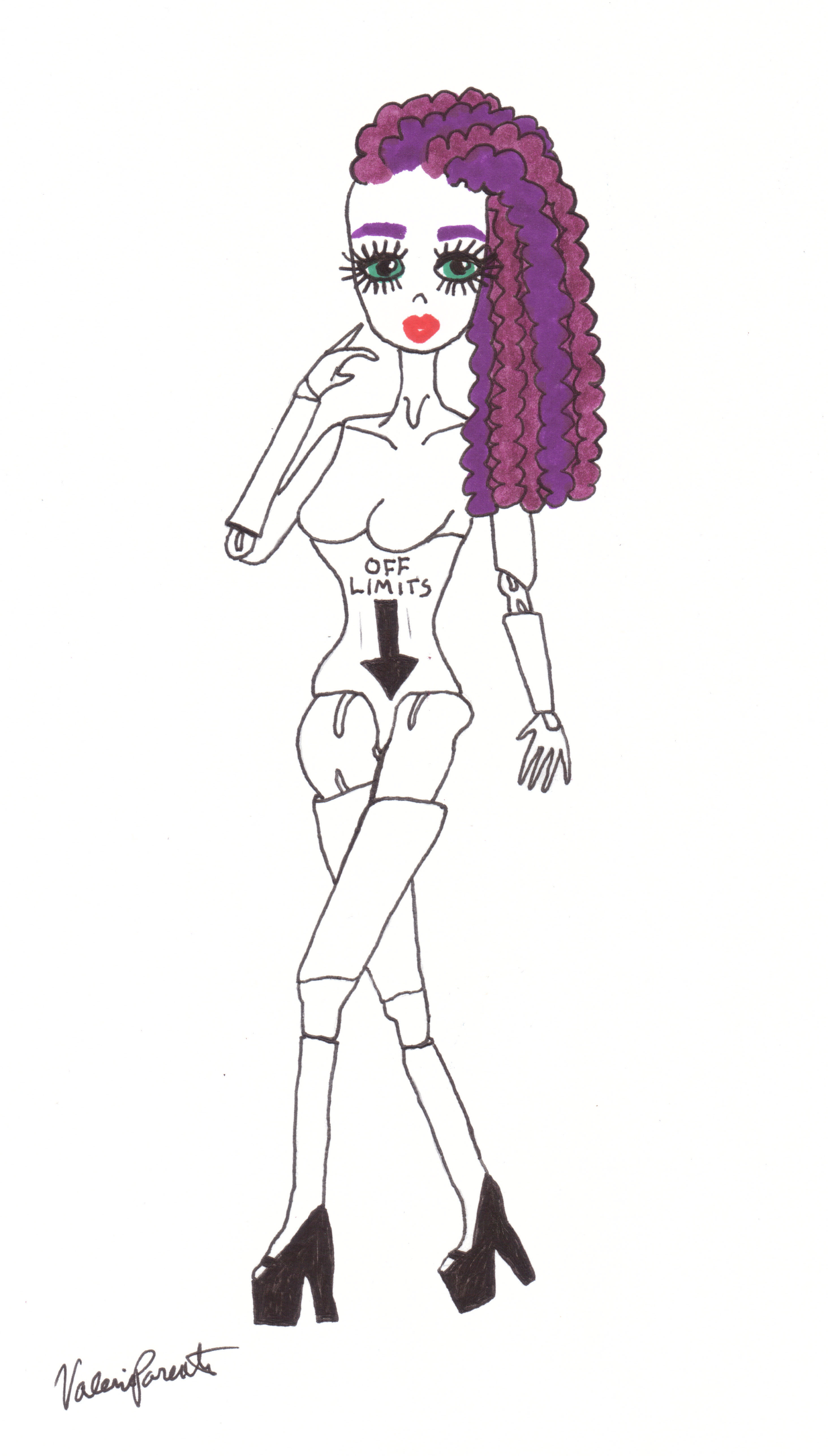
Self-Preservation by Valerie Parente
It’s not being prude
its self-preservation
it’s protecting thyself from everyone else
in an attempt to preserve
the life lessons I’ve earned
because what could be worse
than losing the individual I learned.
I swear, this fear of intimacy
is not a fear of what’s in me
it’s fear of a touch that might corrupt
everything I’ve ever dreamed of.
Because what happens when I open up?
Would it change the person I was?
I’ve spent a lifetime learning who I am
and I’m so deeply scared
of my worldview crumbling at another’s hand.
– Valerie Parente (1-3-2020)
Aesthetic Reality

Aesthetic Reality by Valerie Parente
You’re starting to realize that reality is subjective
and perception is the byproduct of perspective
Now you’re deciding not to be fooled by the deception
that self-respect is determined by rejection
as if your meaning is for someone else to measure.
But the truth is that you get to choose your mood
because your personhood is dictated by the personal
and aesthetic stems from what makes you authentic.
– Valerie Parente (5-12-2019)
Switching Perspectives (Analysis of In Touch) [Part 1]
Why is it so much easier for me to write from the point of view of a male? In Touch, being the third story I’ve completed, was by far the most effortless piece I’ve written to date. One could claim this is because the themes of In Touch were purely an autobiographical experience against the backdrop of a fiction story. The odd but magical part of writing this book, though, laid in the fact that I was writing about obsessive compulsive disorder from an outsider’s point of view… a male’s point of view. Sitting in this Starbucks, for the second Sunday in a row, now writing scenes for another story through a male narrator, I find myself asking the question- why is writing from a male’s perspective so much easier for me? My guess is that it has something to do with the prisons we call ego and expectations.
If you’ve read any of my poetry and prose work then you’ll quickly realize it is no secret that I am extremely tied to my female identity. So you would think I would write more effortlessly from the female point of view, but from a personal standpoint that just doesn’t feel like the case.
In Touch was honestly the easiest book I’ve written to date. Was it the “best”? I don’t know. But it was certainly less difficult. Most notably, it was effortless. The words flowed from my brain with no hesitation. I barely had to think. I just wrote. I remember lying in bed scribbling dialogues between the main characters, Jef and Lacey, with no interruption of thought. I remember phrases and comments popping in my head when I was working my retail job and jotting them down on scrap pieces of paper. Many brief but key comments unraveled into beautiful chapters and concepts that I genuinely do not feel took any brain power. They just popped into existence and my mind acted as the translator between wherever art spawns and where it is destined to be recorded. Bringing my daily thoughts and imaginary conversations alive on paper was as easy watching TV.
Writing as a person who is so obviously not me, that being a young man, brings no pressure. There’s no ego conflicts or stress to “get it right”. Any expectations I have on the identity I project to the world is irrelevant. All that matters is writing meaningful passages. The ego that haunts “Valerie” is no longer in control. It really is freeing. I imagine this kind of disconnect from the self but connection to the collective consciousness that is the rest of the world is what it is like to feel free. And for this reason I think I not only have a more effortless experience purging the words on paper through a male narrator’s voice. The idea that it is easier to write as somebody who is not me is rich with irony, and that fascinates me more and more every day.
When I have writer’s block I look at that 488 page novel and wonder how the heck I did that. Then at moments like today when I started writing from another male narrator’s perspective new words flowed instantly and I remembered what it was like to be inspired.
Yes, I identify with all my narrators to some extent. We do share the same brain after all. But there’s something flawless and liberating about writing without Val’s ego and Val’s expectations breathing down my throat. No interruptions. It’s easier to write and write and write until the thoughts dry out. I feel more “natural” writing as a different gender and identity, and I think that’s why In Touch came out exactly as I dreamed it would.
To purchase In Touch you can go to Amazon.com!
“In Touch” by Valerie Parente
I have officially published my first full length fiction novel, “In Touch”!
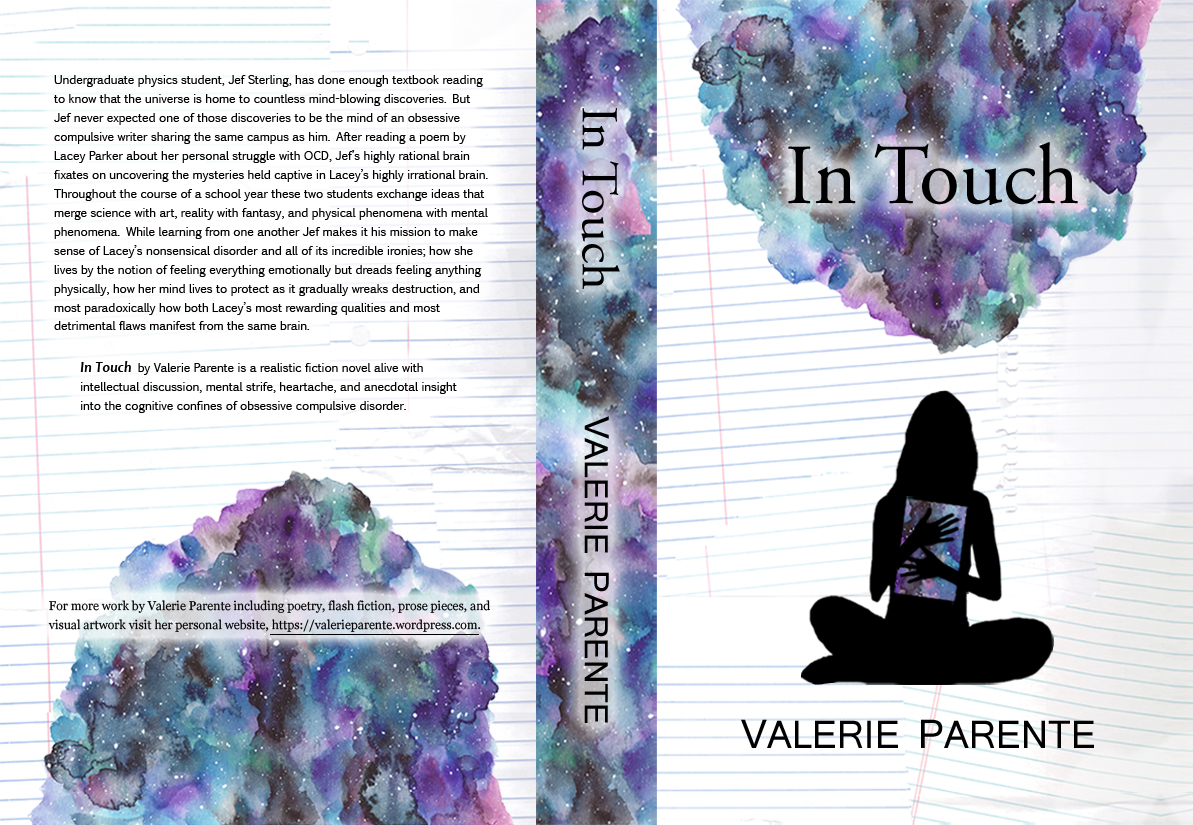
You can purchase “In Touch” by Valerie Parente on Amazon.com
Buy “In Touch” by Valerie Parente
“Undergraduate physics student, Jef Sterling, has done enough textbook reading to know that the universe is home to countless mind-blowing discoveries. But Jef never expected one of those discoveries to be the mind of an obsessive compulsive writer sharing the same campus as him. After reading a poem by Lacey Parker about her personal struggle with OCD, Jef’s highly rational brain fixates on uncovering the mysteries held captive in Lacey’s highly irrational brain. Throughout the course of a school year these two students exchange ideas that merge science with art, reality with fantasy, and physical phenomena with mental phenomena. While learning from one another Jef makes it his mission to make sense of Lacey’s nonsensical disorder and all of its incredible ironies; how she lives by the notion of feeling everything emotionally but dreads feeling anything physically, how her mind lives to protect as it gradually wreaks destruction, and most paradoxically how both Lacey’s most rewarding qualities and most detrimental flaws manifest from the same brain. In Touch by Valerie Parente is a realistic fiction novel alive with intellectual discussion, mental strife, heartache, and anecdotal insight into the cognitive confines of obsessive compulsive disorder.”
– Valerie Parente (8-5-2018)
Evolutionary Theory: An Empirical Framework for Psychology
Valerie Parente
September 27, 2017
Evolutionary Theory: An Empirical Framework for Psychology
Over the 150 year span since Darwin introduced the theory of evolution, with the publication “On the Origin of Species”, evolutionary concepts have been the backbone to many (but not all) psychological models. It is the hope of David M. G. Lewis and Laith Al-Shawaf that principles such as natural selection will lead to middle-level theories, then resulting in hypotheses that “generate testable empirical predictions” (2017). After reading the “Evolutionary Theory and Psychology” science briefs published by the American Psychological Association, Lewis and Al-Shawaf’s “Evolutionary Psychology: A How-To Guide” through applying evolutionary theory to behavioral sciences, and the collection of PowerPoint presentations compiled by Assistant Professor Joseph E. Gonzales, I have come to the conclusion that evolutionary theory has a crucial role in unifying the subfields of psychological science and serving as higher level explanatory model for human behavior.
Charles Darwin’s influence has already permeated the social sciences. Research Professor of the University of Michigan, Daniel J. Kruger, references one example in Bowlby’s 1969 child-primary caregiver attachment model (the proposition that if a child is separated from his or her caregiver for a lengthy duration of time then their relationship would become strained). Lewis and Al-Shawaf mention the “dual mating strategy hypothesis”, a proposition that women have psychological adaptations surrounding their ovulatory cycle which motivate them to search for long-term relationships with men who will invest in them and short-term mating with men of high genetic quality during their most fertile phase. Things get a little more complicated when observing the alternative evolutionary explanations to such a phenomena, which Lewis and Al-Shawaf split into “alternative function” (how observed findings could be the output of an adaptation meant to solve a different problem of the species), or “incidental byproduct” (a differing hypothesis that results in the same set of findings) (Lewis & Al-Shawaf, 2017). Clearly there are a lot of nitty-gritty details to evolutionary theory to consider if one is to properly use it in creating middle-level theories, thus justifying Lewis and Al-Shawaf’s well structured guide to developing hypotheses.
If evolutionary theory is to seriously be applied to the social sciences then it must initially be taught correctly, and in full. Debra Lieberman of the University of Miami and Martie Haselton of the University of California (2017), argue that without serious education in evolutionary biology, psychologists risk inaccurately incorporating concepts, like sexual selection, and, consequently, misunderstanding psychological science. Based on our human sexuality lectures and Lewis and Al-Shawaf’s “How-To Guide” to approaching psychological science with evolutionary frames, I would have to agree that ideas like selective pressures of an environment or predator/prey relations could easily become misconstrued or misused without proper training. This is very key to evolutionary theory, and to overlook such a concept is to do nothing but a disservice to the social sciences which have spawned from the study of life (biology). If we want to look at phenomena, one example being clinical psychological disorders, through a purely scientific and modern lens then ideas like adaptations and selective pressures should, at the very least, have a place in the conscience of every psychological scientist.
What personally struck a chord with me throughout the readings of evolutionary theory was how sensible and logical it would be to approach psychology in this way. My greatest abhorrence to Sigmund Freud has always stemmed from his lack of scientific thinking. I found significant similarities between my aversion to Freud and Lewis and Al-Shawaf’s critique of psychological science studied without evolutionary theory. For instance, Freud’s psychodynamic hypotheses about the subconscious and deep desires were radically metaphorical. He enacted no scientific method in coming to such conclusions about the human brain. The id, the ego, and the superego, are none other than metaphors for human consciousness. While beautiful in literary and artistic terms, this is a far cry from scientific. Evolutionary theory, a consistently supported theory amongst the scientific community, would be lost if every psychologist approached the study of mind and behavior with metaphors in the way that Freud did. His methods of “theorizing” have no rightful influence on modern research methods. It is wildly refreshing to know that the American Psychological Association and the psychological community as a whole are beginning to seriously apply some sort of scientific method and model to its research.
In summary, all of these articles reiterate the common theme: that evolutionary theory should be treated as a valid and empirical-bound framework of psychological science. I agree with this notion. Though looking at the human mind from a spiritual, paranormal, and sometimes religious angle can offer vivid metaphors and analogies for theories about the psyche and behavior, this Freud-reminiscent methodology (or lack of) is outdated. If we want to keep the “science” in psychological science then we need higher-level evolutionary models, hypotheses, and theorization drawing from a biological perspective as relevant and reliable as Darwin’s theory of evolution.
References
Kruger, D. J. (2017). Evolutionary Psychology and the Evolution of Psychology. Evolutionary Theory and Psychology, 3/11-4/11.
Kurzban, R. (2017). Darwinizing the Social Sciences. Evolutionary Theory and Psychology, 4/11-5/11.
Lewis, D. M., & Al-Shawaf, L. (2017). Evolutionary Psychology: A How-To Guide. American Psychologist, 72(4), 353-373.
Lieberman, D., & Haselton, M. (2017). Darwinian Psychology: Where the Present Meets the Past. Evolutionary Theory and Psychology, 5/11-6/11.
Cynic
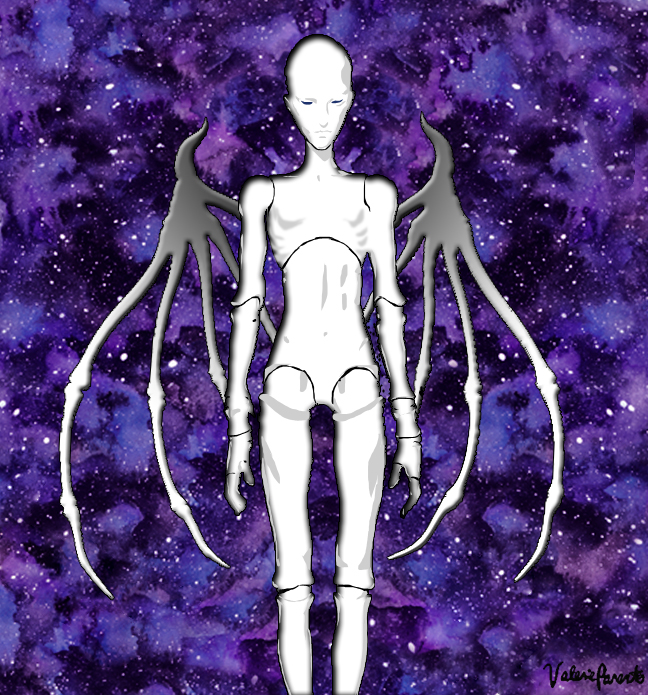
“Devil’s Advocate” by Valerie Parente
Cynic by Valerie Parente
He has a very quick wit and he uses it to guard himself
Always the cynic, never fails to cast a doubt
Playing devil’s advocate to get a rise from the crowd
But I think there’s a twist he doesn’t want figured out
I’ve begun to notice that the words in his mouth
Are fueled by conflict but claim an impartial sound
He declares disinterest, yet he still sticks around
While using logic to debate rational grounds
This seems to contradict the face of a neutral account
Because no true nihilist has a belief worth caring about
I know when he reads this he’ll just shut me down
He’ll laugh and dismiss the complexity I’ve announced
With the same rhetoric that makes him so profound.
– Valerie Parente (3-5-2018)
The Artist, The Muse: A Poetry & Prose Collection
The Artist, The Muse: A Poetry & Prose Collection by Valerie Parente OUT NOW
Buy THE ARTIST, THE MUSE Via Amazon
The Artist, The Muse is what you get when you interweave psychology, creativity, and spirituality into the poetic fabric of a mentally disordered daydreamer’s mind. Valerie Parente artfully hones the craft of written word in this collection of poetry and prose through fantastical metaphors, rhythmic patterns, heartfelt emotions, metaphysical references, and breath-taking epiphanies. Dark daydreams and silver-lining mantras blossom out of the obsessive compulsive writer’s verbal landscape as the artist becomes her own muse.
Includes poetry, prose, and artwork by Valerie Parente.
Table of Contents:
The Artist, The Muse
Conscience of Nonsense
Glitter In The Air
Shy of Me
The Gargoyle Mindset
An Inadequate Reflection
Ink
You’ve Made An Author Out Of Me
Essence
Grandiosity of the Sick
Daydreams Are Shadows
Sanctuary
Hindsight of the Falsehood
Echoes
Idu Ego
The Silver Screen
Realize These Butterflies
The Writer
Natural
The Instinct of Intuition
The Masterpiece Tragedy of Marionette
Egomaniac
Inquiries
Playing with Dolls
Imagination Is Not Free
Validation
I Wish You Well
Bleeding
Paradox Lock
Dreams of Floating
Give & Take
Her Bright Pink Shoes
Why I Apologize
My Heart Thaws
Mars
Sage of Tarkus
Normal
The Creeper
Young Sapling
Scarecrow
she could not master astral projection
Touch the Heart
Creator
To Be Human
Lady Luna and the Light Inside
Tiara
The Answer
Order In Disorder
Trust the Stars
Novelty
Message From The Universe

 valerieparente