Matter: A Symbol of the Mind

Mind generates the fear.
Matter symbolizes the fear.

Obsessive compulsive disorder likes to customize itself according to whichever person it sinks its parasitic teeth into. My list of OCD anxieties is different from another person’s list of OCD anxieties. Though the content in each OCD list might vary between person to person, the layout remains quite uniform.

In the left column we have an intangible thought (a fear of something), and in the corresponding right column we have a more palpable experience or object (that actual something).

These obsessive thoughts, which forbid or demand certain compulsions, are exponentially more anxiety evoking than physically bringing one’s self to the point of defying said-thought.
To put this notion in perspective, take general anxiety into account. A common example is the fear of public speaking. When you have anxiety about going on stage and talking to a crowd the fear building up to delivering a speech is so much worse than actually delivering the speech.

a conscience full of nonsenseNow revert this idea back to OCD. When I say I am afraid of germs it is my fear of going into a bacteria-ridden public place that causes me more distress than physically walking into the actual setting and realizing, through exposure, that, “hey, I can deal with this”. This is not to say that I do not get anxious when I think I have been contaminated by germs- trust me, I do- but is it the physical germs that are causing the anxiety or a thought itself that causes the anxiety? It is the thought. That irrational frequently occurring thought. The physical germ is just a symbol of the fear having been generated from my mind.

Fear comes from the mind, not from matter. And as much as I want to believe that there is some reasonable connection between my thoughts and the material world I cannot deny the factual evidence that my obsessive compulsive fears are what stir up anxiety, not the actual events or objects which those fears are based on.

– Valerie Parente (6-13-16)

The Masterpiece Tragedy of Marionette

Marionette shines in the spotlight.

“You are a superstar, young lady!”

“I am no more than a puppet attached to the make-believe! These ideal scenarios! These insurmountable expectations! These flashing images of perfection! My imagination pulls the strings!”

“But you are at the center of the stage!”

“I am tied back by the theatre of an overactive imagination!”

With a razor in hand Marionette breaks free and collapses, for she never properly learned how to keep her feet on the ground.

The Masterpiece Tragedy of Marionette

– Valerie Parente (6-7-16)

The Writer

purple meadow

The Writer by Valerie Parente

“Hi Val, come in,” the therapist greets
Enter with my lovely OCD
Sink in the contaminated chair
And try to explain my warped despair.

The woman just glances at me with judgement
Then she stops and asks a question
Not the obligatory cliché
Some recycled “How are you today?”

She prods to crack my skeletal shell
“Surely you see this means you’re unwell.”
I politely smile and breathe in
“No, it just means that I am different.”

Then I hand her my special page
As she reads her eyes drastically change
So now the lady with the degree
Is dumbfounded by what I conceived.

She looks up at me with new insight
Pupils touched by dark reflect my light
“How can someone so delusional,
Write something so profound, yet simple?”

I just shrug and wonder what to say
Do I indulge or act modestly?
The answer that always hums along
Is “say the truth, you cannot be wrong.”

My tightened lips part and I respond
“Yes it’s easy, the words just flow on
From a place that I cannot describe
My own twisted form of paradise.

Nobody can see this place but me
A heaven locked away in daydreams
I can feel it when I am alone
So I write about it when at home.

All I do is reach inside my mind
To channel with that endless supply
Of the right thoughts which describe my pain
Diction that captures what I can’t say.

You are just witnessing a small piece
Of the landscape my mind embodies
The only way I can get you here
Is through ink made from a very true tear.”

My mouth shuts and the room is quiet
A mental expert can’t define it
I see she is disturbed but in awe
With my mouth I continue to draw.

“I’ve been like this as long as I know
Able to put on paper and show
All the crazy and wild distortions
That come with a storm of emotions.

Too complex for me to vocalize
But written, perfectly summarize
An imaginary world of mine
Of darkness mixed with thoughts I can’t cry.

It’s funny because as I look back
At the moments where normal kids laughed
My ideas that peers could not connect
Even my teacher called incorrect.

My strange mind’s light was perceived as dumb
So I tried to dim the ideas from
A world I thought was smarter than me
But the truth was it was not ready.”

“Do you think you are brilliant?” she asks
“Like a savant?” I begin to laugh
“I know when I say yes I’ll be
Deemed mental with grandiosity.”

The only response is her sly grin
Presented for my interpreting
I do not know what to say from there
So I resort to silence and stare.

I’m aware my honest blackened eyes
Painted with gloom now epitomize
The special gift I have always been
Perfecting in my isolation.

A talent and a mental disease
Together create such irony
Because the darkness that I write about
Always makes my inner light come out.

– Valerie Parente (6-5-16)

Delusions from Obsessions

When you’re young and you start experiencing obsessions you don’t realize the delusional depth of what’s happening to you.

You naturally assume that the reason you keep uncontrollably thinking of a certain boy is because you’re falling in love with him, not because you have an intrusive image generator mounted inside your brain which has been programmed to stutter on a motif. The particular motif of a nice kid who smiled at your vulnerable teenage heart in the hallway resonated strongly, and as OCD does so well, it latched onto that strong experience and spit out recollection after recollection. But recalling the same smile in a hallway gets duller with each replay, so you have to improvise, and you start imagining perfect scenarios, eventually conjuring up a delusional perception of a person you idealized, not who that person really was in reality… and a whole bunch of kids look at you as “that psycho girl”.

You not only delude your idea of other people, but yourself as well. You cognitively isolate yourself, thinking you understand reality on a deeper level than most people because your cycling mind has convinced you, through the illusory power of repetition, that your perceptions of particular experiences were more meaningful or intense than they really were. And, of course, you are a young teenager and “nobody understands” you.

Pyscho Girl

It has taken me a good eight years of hindsight, since my “outburst” of obsessive compulsive symptoms, to realize that a lot of my more confusing and painful experiences were not based on reality, but were side effects of an OCD I had not yet gotten the diagnosis for. I would be lying if I said I had zero level of resentment whatsoever over how things played out during the teenage years of my life (which are already inherently difficult for everybody), but I am not lying when I say that I have zero level of resentment towards myself for not initially realizing how delusional my perceptions of reality was. I wasn’t getting treated for OCD at the time, and I was keeping it to myself. So obviously I was bound to construct some pretty delusional heuristics for perceiving the world.

It is perfectly okay not to realize, until hindsight, that you did not see a situation or yourself in a realistic sense. Nobody questions the validity of their own thoughts without some kind of third party intervention. This is why keeping your pain to yourself is so detrimental. You are bound to be deluded by pain seen through no perspective but your own (and I’d advocate that this goes for people in general, with or without mental illness). Viewing your perceptions of a situation or yourself from an outside perspective- whether that means physically addressing somebody else for their opinion, taking a step back and trying to see your situation in the big picture, or simply talking out loud about your situation to another human being- can eliminate any potential delusions that might contribute to a whole lot of unreasonable pain which will have to be decoded eventually.

– Valerie Parente (6-2-16)

Two Types of Inspiration

yellow tulips

In artistic creation there are two types of inspiration, one which blooms from the conscience and one which blooms from the subconscious.

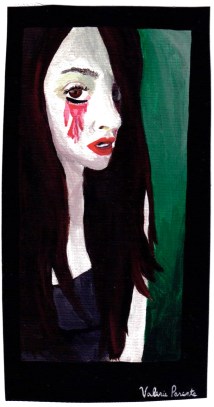
The first is when you get inspired by an emotional experience then try to immortalize the imprint of that experience through art. The second is when you, under the influence of a thoughtless drive, create something without fully understanding why then take step back and analyze where in your psyche that inspiration was rooted. Working backwards to find out why it is so aesthetically fulfilling to paint blood stain tears underneath your eyes or scribble decaying trees in illustrations.

– Valerie Parente (5-31-16)

Susceptible to Growth

I’m not scared of relationships, I’m scared of making a shift from friends to more than friends.
I’m not scared of going out to eat, I’m scared of breaking my streak of home cooked meals.
I’m not scared of moving on, I’m scared of re-establishing myself on new ground.

When trying to dissect exactly what it is about change that is so scary I’ve come to a couple of conclusions (all idiosyncratic to my own personality and emotional history- so, as usual, I cannot speak on behalf everyone suffering from obsessive compulsive disorder); but if I had to pinpoint the sole problem I have with change that I think would most resonate with other OCD sufferers then it would be how in a ritualistic mind change can imitate an intrinsic kind of susceptibility.
To physically change my placement or what I surround myself with, to literally and figuratively put myself out there in an unfamiliar situation with unfamiliar factors is to open myself to a universe of possibilities I have no practice in handling. I cannot guarantee I know how my personality will handle new and different experiences and to somebody who is constantly trying to decode the intermingling of their identity with their mental illness this is nothing short of terrifying.

Equating susceptibility on an identity level is developmentally crippling. Any kind of milestone, an experience or event that should be cherished, could easily be seen with a negative connotation (hence the examples of misconception that I’m simply afraid of being in a relationship, eating at a restaurant, or moving out into a new environment). This kind of mindset is not fulfilling and that’s not fair.

In my OCD fight I’m going to consciously equate change with a more positive connotation- one of growth and blooming. One where getting to the next level, transitioning, and graduating into new milestones will be viewed like pouring water on a blooming identity, to further discover what kind of beautiful flower it will be rather than suppressing it to a bud or a stem without its floral crown.

nourishing a blooming identity

Change will nourish you, not hurt you. And unfamiliarity forces you to become more familiar with your identity by shedding light on how you handle certain experiences. Growth helps you become a more complete you. Making your identity susceptible to growth should be seen as making yourself available to a new level of beauty that only life experience can elicit.

Change welcomes susceptibility, but susceptibility welcomes growth.

– Valerie Parente (5-24-16)

Personal Business

tulips

To have a career creating art must be very rewarding, but also very exhausting. As a professional artist there is no separation between your work life and your personal life, because your business draws from your personal business. Still, I can’t imagine a career avenue more perfect.

– Valerie Parente (5-16-16)


Aesthetic & Psychological Tree

Skeletal Branches

“The beauty in bare tree branches is how they resemble the skeletal roots in which they grow from.” – Valerie Parente (5-14-16)

Obsessive compulsive disorder has taken captive my once free hands in a misguided attempt to protect them. And as I have said before [see Raw Proof] my hands suffer from severe dryness because of frequent and thorough hand washing compulsions. So when I paint a creepy black tree on my hand it is an act of rebellion, not simply because it is a beautifully dark depiction, but because it is my way of liberating the primary physical area that OCD has manipulated. By painting something that is aesthetically pleasing to me on the area which most symbolizes my obsessive compulsive disorder, I have taken that area back and reclaimed it as my own.

OCD can crack and damage my hands all it wants, but at the end of the day my hands belong to me, Valerie, not this mental disorder. And if I want to paint a skeletal tree on my hand because it makes me feel strong in the midst of a crippling mental disorder then you bet I am going to paint a tree.

– Valerie Parente (5-14-16)

Relevance

Finding your identity is not a process of elimination. You do not look at everything outside of yourself and say “not me” then look at what is left and label it “me”. You and everything in the universe are relevant to each other. And you will never truly discover who you are by isolation. You will discover who you are by recognizing yourself as a part of the whole that is the world.we are all relative

– Valerie Parente (5-11-16)

Raw Proof

Obsessive compulsive disorder is a mental disorder, we all know that. But we don’t always treat it like a disorder. A lot of people treat it like it is some handy character trait people have when they organize their folders alphabetically or keep their house nice and tidy. I can’t stress enough how misconstrued that perception is. But as I said, OCD is a mental disorder, and it is hard to perceive something that goes on inside somebody else’s mind. Mental disorders aren’t exactly known for being diseases obvious to human perception. People do not easily see how OCD can be dangerous. People do not easily see how OCD can be painful. People do not easily see how OCD does more harm than good.

So what do people easily see? Their hands. I remember reading some article online about how you see your own hands more than you see anything else in the course of your day and I have no problem believing that to be true. And this idea of the common sight of your own hand reinforces the eerily symbolic relevance behind a concrete outcome of one of the most commonly known OCD compulsions, hand washing.Raw Proof

The ugly results of frequent and vigorous hand washing was the closest thing to a physical side effect of my obsessive compulsive disorder. The arid patches and deep cuts coating my knuckles, palms, and fingers were literally and figuratively raw proof of the OCD. Through a persistent urge to sterilize the skin on my hands, an urge that I still can’t shake to this day, the mental illness going on inside of me had manifested itself on the outside as well. And although I manage it better now, in the thick of my battle with OCD my hands would bleed and burn at the slightest tightening of a grip or bend of a finger. Each bloody fissure carving its way through the sandpaper flesh on my hands was raw proof that OCD is not just some cute quirky habitual personality trait, but actually a very painful and harmful disorder.

– Valerie Parente (5-9-16)