The Miracle of Language

darkI correct people’s grammar. I criticize poorly worded sentences in commercials. I cringe at ridiculous lyrics sung on the radio. I proofread my text messages before sending them. But I think the reason language is important to me is because so often I have a jumble of irrational snippets of information and lacerated thoughts senselessly flying around my head. So to be able to pull that structureless jumble outside of my own head and construct it into coherent sentences is a big deal for me. To be able to put into words what doesn’t quite make sense to me is nothing short of a miracle.

– Valerie Parente (5-6-16)

Trust

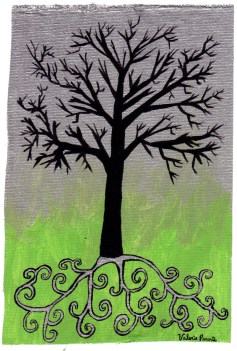
Uprooted

Trust is a big issue in people with obsessive compulsive disorder. They have difficulty trusting that the environment is not this inherently dangerous place out to get them. That’s why they design often ridiculous compulsions to ward off what they perceive as constant impending harm. And if, by some miracle, a person with OCD is compelled to oppose their specifically designed safety ritual they once again face this trust issue, because to resist a compulsion is to let go of an insurmountable aching for control and trust that the world will not punish them for giving into the natural order of things– a natural order that they must trust is predominantly benevolent.

– Valerie Parente (5-2-16)


Damsel in Distress

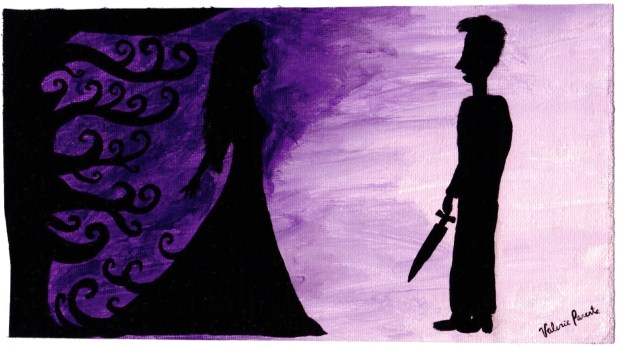
Damsel In Distress

“Damsel In Distress” by Valerie Parente

Growing up I admired the damsel in distress in every movie I watched. The scenes that got me most excited? When an emotionally invested prince caught a glimpse of his princess in trouble. Not the spectacular moment right before when he swooped in on a stallion or right after when he saved the princess by slaying a dragon, but that exact moment in between. That fleeting succession of frames where the prince’s poignant eyes fixed on the princess writhing in her conflict and you could see him processing the sight. That, to me, was the pinnacle of romantic. The simple act of boy witnessing girl. And, in hindsight, I think that warped level of infatuation that I had as a child alluded just how prevalent daydreaming would be to my emotional being. Because that moment when the prince watched his true love suffer wasn’t some concrete action of heroic proportions with no substance further than what it offered visually. That moment was an intimate connection where one character mentally absorbed the dire state that another character was in, and it gave me as a wide-eyed viewer an empathetic opportunity to freely imagine what prince charming and his straining heartstrings might be feeling regarding his beloved. And that practice of fantasizing his emotions through the infinite flux of my own imagination provided nothing but ecstasy for the emotional daydreamer in me.

– Valerie Parente (4-28-16)

Echoes

Echoes
“Your thoughts are synonymous with echoes,” he tells her.
The carefully constructed sentences, spontaneous words, even fragmented enunciation playing out in her mental script are no more or less compositions of sound waves bouncing back and forth in the maze of her mind. Echoes, reflecting off of walls that are as jagged as those doodled by this daydreaming girl who has been half-listening in class. But half of her half-listening is because the thoughts playing out in her own mental labyrinth are lingering. It is not so much a matter of volume, but of frequency. Her echoes reverberate long past the initial sound has run its course. They repeat, repeat, repeat. She can hear the echoes going on and on, cycle after cycle, aware of their questionable rationality because nobody outside of the maze walls seem to be able to hear what she hears. Not even him.
In an effort to make sense of the auditory world reflecting and bouncing inside her she measures these echoes in the same way she measures the dissonant, yet not so distant, world around her- first by participating in the world, second by dissecting the emotional content that transpires by said participation.
She sits back and listens.
The echoes conduct her. Using her instrument of a body she carries out the actions in demand. And what happens… what happens is strange. Is that… is that harmony that she hears?
The echoes that first caused so much panic were silenced upon obedience. It seems that resonating with the echoes was key in tuning them out. She makes mental note of this auditory pattern.
But what transpires when a mental note is jotted down in a mentally disordered mind?
“Your thoughts are synonymous with echoes,” he tells her.
And so on, a new echo starts. This illusory harmony was none other than noise in disguise, false harmony, proving that the only way to tune out an echo is to incite a new echo, conquer a current obsession with a new obsession. The cycle goes on. A natural frequency, the frequency she most prefers, is not the default for the unnatural maze of a mind. But she knows that she will learn to be okay with this. Because though he cannot hear her echoes, he is receptive enough to acknowledge that she can. And that is true harmony.
Serenade

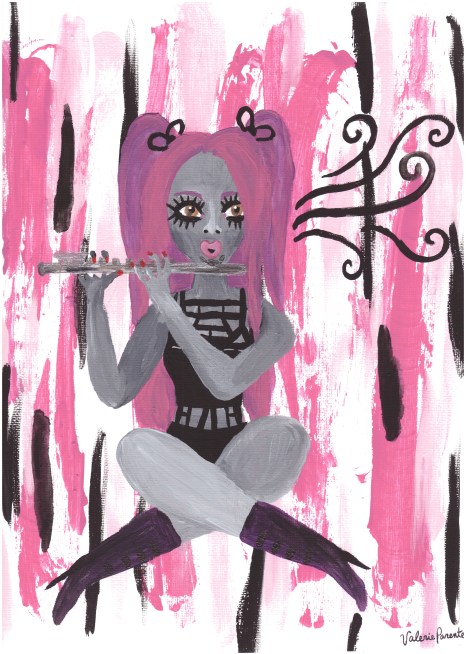
“Serenade” by Valerie Parente

– Valerie Parente (4-23-16)

You Believe, Then You Perceive.

I think a key difference between the healthy mind and the obsessive compulsive mind is that the obsessive compulsive mind is programmed to work from the inside-out, rather than the outside-in. You firmly believe from a place within your mind that the world is scary, so you perceive the world as scary. You don’t fear touching a doorknob because you have superhuman vision that allows you to see every microscopic germ on the metal knob. You fear touching a doorknob because there is an inner conviction telling you the doorknob is irrevocably contaminated with germs.

The OCD masters this process where your skewed beliefs from your distorted mind spill out into the real world, subsequently skewing your sense of perception. And you don’t recognize that you are seeing the world at a warped angle because, to you, the outside is in perfect alignment with the inside.

You believe, then you perceive.

-Valerie Parente (4-18-16)

Grandiosity of the Sick

Grandiosity of the Sick by Valerie Parente

When retention of information is censored through sanity
then attention from the psychologically challenged must rely on vanity.
It is a self-centered way to overcompensate
for what we lack in our mental state.
I call it Grandiosity of the Sick.
The glorified martyr heuristic.
Where those of us who struggle hone our inner pain
through an art quite prone to become vain.
Thinking the anguish we feel is profound.
As if to be miserable puts us on higher ground.
Saying those who reject our thought process
don’t understand because we’re too complex.
Creating beauty from our moping
is a dangerous form of coping.
Because perceiving mental malfunctioning as our best,
can lead to believing we’re only useful in our distress.
But to call this warped mindset a stigma is not entirely fair,
because what could be more admirable than finding comfort in how we’re impaired?

 – Valerie Parente (4-13-16)

Validation

Valerie Parente (handwritten)

I think, from a psychoanalytical standpoint, one of the key reasons I write down my thoughts and daydreams is to validate my own stream of consciousness, as if ink on paper could assert the existence of my mind in this overwhelming universe.

– Valerie Parente (4-8-16)

Being the Judge

To be able to healthily manage obsessive compulsive disorder is to be a constant judge. To incorrectly differentiate which thoughts are skewed projections of anxiety and which are valid fears is to do myself an injustice. And, contrary to common assumption, this job requires an emotionally impartial scrutiny of mental territory that goes beyond fear-based thoughts. Almost every rational thought has an irrational OCD counterpart ready to creep in and mimic sensibility.
Is this paranormal knowledge of “what feels right” the art of sharp intuition, or the convincing trickery of delusion?
Is this opposition a factor of my inborn personality or nurtured disgust?
Is this repetitious daydream an inspired fantasy, or just intrusive imagery?
Is this throbbing adoration love at its truest, or obsession at its sickest?
At the end of each trial, whether the verdict places cognitive guilt on obsessive compulsive disorder or not, this disorder still and always manages to uproot a deep-seeded philosophical conflict within me. If a foreign entity is responsible, even if only occasionally, for my brain’s generated thoughts, then who do I call Valerie? Can the “self” really exist in a mentally ill brain?

– Valerie Parente (4-2-16)