The Gargoyle Mindset

The Gargoyle Mindset by Valerie Parente

Behold the gargoyle mindset
This is an anxiety complex
The result of an artistic process
By a paranoid architect.
A sculpture so grotesque
Created to act as a fortress
A creature against all the darkness
Featured along a flying buttress.
The gargoyle awaits upon his tier
But its purpose has begun to veer
Going from complacent to cavalier
A defense mechanism with a spear.

In the gargoyle mindset
Anxiety is placed with fret
On the outside it sits
For all to witness.
Once designed to protect
Became its own threat
A public display of stress
Notorious in all its ugliness.
Sometimes our minds equate safety with fear
And we get caught up in this superstitious idea
That to scare off the scary coming near
We have to create a scarier peer.

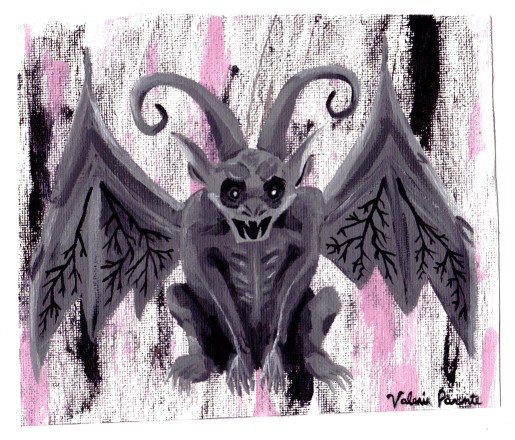
A Gargoyle Named Anxiety

“A Gargoyle Named Anxiety” by Valerie Parente

– Valerie Parente (5-22-16)

Personal Business

tulips

To have a career creating art must be very rewarding, but also very exhausting. As a professional artist there is no separation between your work life and your personal life, because your business draws from your personal business. Still, I can’t imagine a career avenue more perfect.

– Valerie Parente (5-16-16)


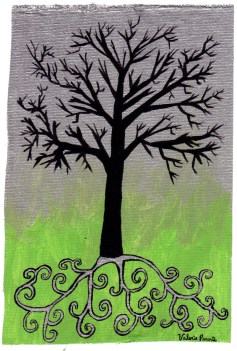
Aesthetic & Psychological Tree

Skeletal Branches

“The beauty in bare tree branches is how they resemble the skeletal roots in which they grow from.” – Valerie Parente (5-14-16)

Obsessive compulsive disorder has taken captive my once free hands in a misguided attempt to protect them. And as I have said before [see Raw Proof] my hands suffer from severe dryness because of frequent and thorough hand washing compulsions. So when I paint a creepy black tree on my hand it is an act of rebellion, not simply because it is a beautifully dark depiction, but because it is my way of liberating the primary physical area that OCD has manipulated. By painting something that is aesthetically pleasing to me on the area which most symbolizes my obsessive compulsive disorder, I have taken that area back and reclaimed it as my own.

OCD can crack and damage my hands all it wants, but at the end of the day my hands belong to me, Valerie, not this mental disorder. And if I want to paint a skeletal tree on my hand because it makes me feel strong in the midst of a crippling mental disorder then you bet I am going to paint a tree.

– Valerie Parente (5-14-16)

Relevance

Finding your identity is not a process of elimination. You do not look at everything outside of yourself and say “not me” then look at what is left and label it “me”. You and everything in the universe are relevant to each other. And you will never truly discover who you are by isolation. You will discover who you are by recognizing yourself as a part of the whole that is the world.we are all relative

– Valerie Parente (5-11-16)

Raw Proof

Obsessive compulsive disorder is a mental disorder, we all know that. But we don’t always treat it like a disorder. A lot of people treat it like it is some handy character trait people have when they organize their folders alphabetically or keep their house nice and tidy. I can’t stress enough how misconstrued that perception is. But as I said, OCD is a mental disorder, and it is hard to perceive something that goes on inside somebody else’s mind. Mental disorders aren’t exactly known for being diseases obvious to human perception. People do not easily see how OCD can be dangerous. People do not easily see how OCD can be painful. People do not easily see how OCD does more harm than good.

So what do people easily see? Their hands. I remember reading some article online about how you see your own hands more than you see anything else in the course of your day and I have no problem believing that to be true. And this idea of the common sight of your own hand reinforces the eerily symbolic relevance behind a concrete outcome of one of the most commonly known OCD compulsions, hand washing.Raw Proof

The ugly results of frequent and vigorous hand washing was the closest thing to a physical side effect of my obsessive compulsive disorder. The arid patches and deep cuts coating my knuckles, palms, and fingers were literally and figuratively raw proof of the OCD. Through a persistent urge to sterilize the skin on my hands, an urge that I still can’t shake to this day, the mental illness going on inside of me had manifested itself on the outside as well. And although I manage it better now, in the thick of my battle with OCD my hands would bleed and burn at the slightest tightening of a grip or bend of a finger. Each bloody fissure carving its way through the sandpaper flesh on my hands was raw proof that OCD is not just some cute quirky habitual personality trait, but actually a very painful and harmful disorder.

– Valerie Parente (5-9-16)

The Miracle of Language

darkI correct people’s grammar. I criticize poorly worded sentences in commercials. I cringe at ridiculous lyrics sung on the radio. I proofread my text messages before sending them. But I think the reason language is important to me is because so often I have a jumble of irrational snippets of information and lacerated thoughts senselessly flying around my head. So to be able to pull that structureless jumble outside of my own head and construct it into coherent sentences is a big deal for me. To be able to put into words what doesn’t quite make sense to me is nothing short of a miracle.

– Valerie Parente (5-6-16)

Trust

Uprooted

Trust is a big issue in people with obsessive compulsive disorder. They have difficulty trusting that the environment is not this inherently dangerous place out to get them. That’s why they design often ridiculous compulsions to ward off what they perceive as constant impending harm. And if, by some miracle, a person with OCD is compelled to oppose their specifically designed safety ritual they once again face this trust issue, because to resist a compulsion is to let go of an insurmountable aching for control and trust that the world will not punish them for giving into the natural order of things– a natural order that they must trust is predominantly benevolent.

– Valerie Parente (5-2-16)


Damsel in Distress

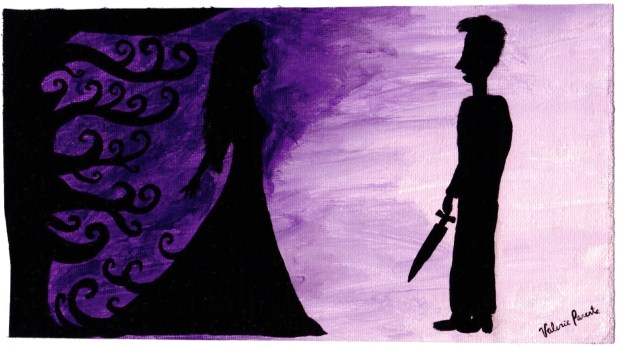
Damsel In Distress

“Damsel In Distress” by Valerie Parente

Growing up I admired the damsel in distress in every movie I watched. The scenes that got me most excited? When an emotionally invested prince caught a glimpse of his princess in trouble. Not the spectacular moment right before when he swooped in on a stallion or right after when he saved the princess by slaying a dragon, but that exact moment in between. That fleeting succession of frames where the prince’s poignant eyes fixed on the princess writhing in her conflict and you could see him processing the sight. That, to me, was the pinnacle of romantic. The simple act of boy witnessing girl. And, in hindsight, I think that warped level of infatuation that I had as a child alluded just how prevalent daydreaming would be to my emotional being. Because that moment when the prince watched his true love suffer wasn’t some concrete action of heroic proportions with no substance further than what it offered visually. That moment was an intimate connection where one character mentally absorbed the dire state that another character was in, and it gave me as a wide-eyed viewer an empathetic opportunity to freely imagine what prince charming and his straining heartstrings might be feeling regarding his beloved. And that practice of fantasizing his emotions through the infinite flux of my own imagination provided nothing but ecstasy for the emotional daydreamer in me.

– Valerie Parente (4-28-16)

Echoes

Echoes
“Your thoughts are synonymous with echoes,” he tells her.
The carefully constructed sentences, spontaneous words, even fragmented enunciation playing out in her mental script are no more or less compositions of sound waves bouncing back and forth in the maze of her mind. Echoes, reflecting off of walls that are as jagged as those doodled by this daydreaming girl who has been half-listening in class. But half of her half-listening is because the thoughts playing out in her own mental labyrinth are lingering. It is not so much a matter of volume, but of frequency. Her echoes reverberate long past the initial sound has run its course. They repeat, repeat, repeat. She can hear the echoes going on and on, cycle after cycle, aware of their questionable rationality because nobody outside of the maze walls seem to be able to hear what she hears. Not even him.
In an effort to make sense of the auditory world reflecting and bouncing inside her she measures these echoes in the same way she measures the dissonant, yet not so distant, world around her- first by participating in the world, second by dissecting the emotional content that transpires by said participation.
She sits back and listens.
The echoes conduct her. Using her instrument of a body she carries out the actions in demand. And what happens… what happens is strange. Is that… is that harmony that she hears?
The echoes that first caused so much panic were silenced upon obedience. It seems that resonating with the echoes was key in tuning them out. She makes mental note of this auditory pattern.
But what transpires when a mental note is jotted down in a mentally disordered mind?
“Your thoughts are synonymous with echoes,” he tells her.
And so on, a new echo starts. This illusory harmony was none other than noise in disguise, false harmony, proving that the only way to tune out an echo is to incite a new echo, conquer a current obsession with a new obsession. The cycle goes on. A natural frequency, the frequency she most prefers, is not the default for the unnatural maze of a mind. But she knows that she will learn to be okay with this. Because though he cannot hear her echoes, he is receptive enough to acknowledge that she can. And that is true harmony.
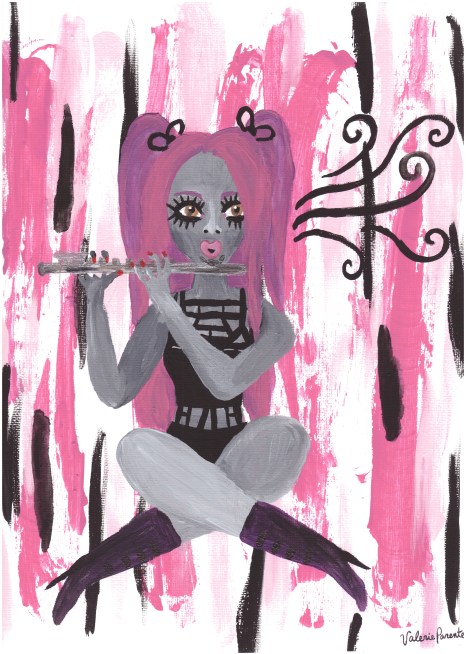
Serenade

“Serenade” by Valerie Parente

– Valerie Parente (4-23-16)