Matter: A Symbol of the Mind

Mind generates the fear.
Matter symbolizes the fear.

Obsessive compulsive disorder likes to customize itself according to whichever person it sinks its parasitic teeth into. My list of OCD anxieties is different from another person’s list of OCD anxieties. Though the content in each OCD list might vary between person to person, the layout remains quite uniform.

In the left column we have an intangible thought (a fear of something), and in the corresponding right column we have a more palpable experience or object (that actual something).

These obsessive thoughts, which forbid or demand certain compulsions, are exponentially more anxiety evoking than physically bringing one’s self to the point of defying said-thought.
To put this notion in perspective, take general anxiety into account. A common example is the fear of public speaking. When you have anxiety about going on stage and talking to a crowd the fear building up to delivering a speech is so much worse than actually delivering the speech.

a conscience full of nonsenseNow revert this idea back to OCD. When I say I am afraid of germs it is my fear of going into a bacteria-ridden public place that causes me more distress than physically walking into the actual setting and realizing, through exposure, that, “hey, I can deal with this”. This is not to say that I do not get anxious when I think I have been contaminated by germs- trust me, I do- but is it the physical germs that are causing the anxiety or a thought itself that causes the anxiety? It is the thought. That irrational frequently occurring thought. The physical germ is just a symbol of the fear having been generated from my mind.

Fear comes from the mind, not from matter. And as much as I want to believe that there is some reasonable connection between my thoughts and the material world I cannot deny the factual evidence that my obsessive compulsive fears are what stir up anxiety, not the actual events or objects which those fears are based on.

– Valerie Parente (6-13-16)

The Masterpiece Tragedy of Marionette

Marionette shines in the spotlight.

“You are a superstar, young lady!”

“I am no more than a puppet attached to the make-believe! These ideal scenarios! These insurmountable expectations! These flashing images of perfection! My imagination pulls the strings!”

“But you are at the center of the stage!”

“I am tied back by the theatre of an overactive imagination!”

With a razor in hand Marionette breaks free and collapses, for she never properly learned how to keep her feet on the ground.

The Masterpiece Tragedy of Marionette

– Valerie Parente (6-7-16)

Raw Proof

Obsessive compulsive disorder is a mental disorder, we all know that. But we don’t always treat it like a disorder. A lot of people treat it like it is some handy character trait people have when they organize their folders alphabetically or keep their house nice and tidy. I can’t stress enough how misconstrued that perception is. But as I said, OCD is a mental disorder, and it is hard to perceive something that goes on inside somebody else’s mind. Mental disorders aren’t exactly known for being diseases obvious to human perception. People do not easily see how OCD can be dangerous. People do not easily see how OCD can be painful. People do not easily see how OCD does more harm than good.

So what do people easily see? Their hands. I remember reading some article online about how you see your own hands more than you see anything else in the course of your day and I have no problem believing that to be true. And this idea of the common sight of your own hand reinforces the eerily symbolic relevance behind a concrete outcome of one of the most commonly known OCD compulsions, hand washing.Raw Proof

The ugly results of frequent and vigorous hand washing was the closest thing to a physical side effect of my obsessive compulsive disorder. The arid patches and deep cuts coating my knuckles, palms, and fingers were literally and figuratively raw proof of the OCD. Through a persistent urge to sterilize the skin on my hands, an urge that I still can’t shake to this day, the mental illness going on inside of me had manifested itself on the outside as well. And although I manage it better now, in the thick of my battle with OCD my hands would bleed and burn at the slightest tightening of a grip or bend of a finger. Each bloody fissure carving its way through the sandpaper flesh on my hands was raw proof that OCD is not just some cute quirky habitual personality trait, but actually a very painful and harmful disorder.

– Valerie Parente (5-9-16)

Echoes

Echoes
“Your thoughts are synonymous with echoes,” he tells her.
The carefully constructed sentences, spontaneous words, even fragmented enunciation playing out in her mental script are no more or less compositions of sound waves bouncing back and forth in the maze of her mind. Echoes, reflecting off of walls that are as jagged as those doodled by this daydreaming girl who has been half-listening in class. But half of her half-listening is because the thoughts playing out in her own mental labyrinth are lingering. It is not so much a matter of volume, but of frequency. Her echoes reverberate long past the initial sound has run its course. They repeat, repeat, repeat. She can hear the echoes going on and on, cycle after cycle, aware of their questionable rationality because nobody outside of the maze walls seem to be able to hear what she hears. Not even him.
In an effort to make sense of the auditory world reflecting and bouncing inside her she measures these echoes in the same way she measures the dissonant, yet not so distant, world around her- first by participating in the world, second by dissecting the emotional content that transpires by said participation.
She sits back and listens.
The echoes conduct her. Using her instrument of a body she carries out the actions in demand. And what happens… what happens is strange. Is that… is that harmony that she hears?
The echoes that first caused so much panic were silenced upon obedience. It seems that resonating with the echoes was key in tuning them out. She makes mental note of this auditory pattern.
But what transpires when a mental note is jotted down in a mentally disordered mind?
“Your thoughts are synonymous with echoes,” he tells her.
And so on, a new echo starts. This illusory harmony was none other than noise in disguise, false harmony, proving that the only way to tune out an echo is to incite a new echo, conquer a current obsession with a new obsession. The cycle goes on. A natural frequency, the frequency she most prefers, is not the default for the unnatural maze of a mind. But she knows that she will learn to be okay with this. Because though he cannot hear her echoes, he is receptive enough to acknowledge that she can. And that is true harmony.
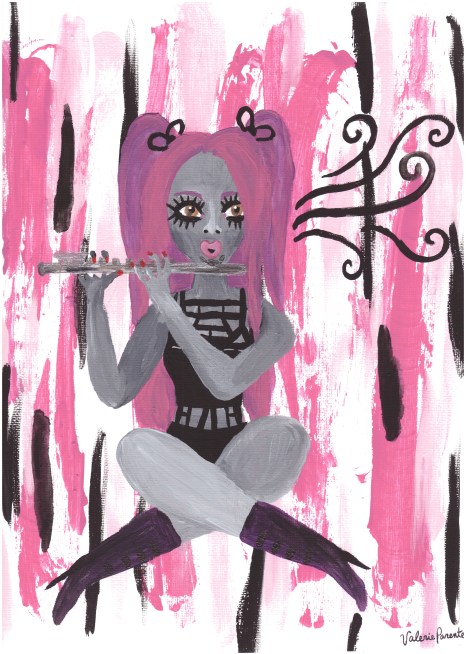
Serenade

“Serenade” by Valerie Parente

– Valerie Parente (4-23-16)