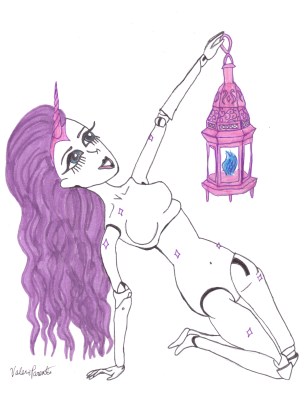
Dissonant Demons

Dissonant Demons by Valerie Parente

My eyes want to cry
but I’m not sad in my mind.
My body wants to be burned
but my heart is already warm.
I’m trying to think of ways
to hurt myself without causing pain.
These demons, they try to stay relevant,
but my glorious God is not hellbent.

Dissonant Demons

– Valerie Parente (3-4-2019)

The entire universe and its blessings are in the palm of my hand

Nebula TreeThe entire universe and its blessings are in the palm of my hand by Valerie Parente

The entire universe and its blessings are in the palm of my hand. I can feel the energy that makes up you and me and everything in between and I am in awe that I did not notice until now how interconnected we all are with the energy we spawned from. I still have longings but I feel so whole and complete like my longings long back for me. I feel that my blessings walk beside me even when they can’t be seen. I am not discouraged when things do not go my way, I am empowered. Every struggle is proof that I am worthy of more than I hoped to settle for and I am in awe and in love with the story the universe writes about me.

– Valerie Parente (9-27-2018)

Shed Your Ego

A lot of your problems stem from the fact that you are tied to your ego. When you can’t let go of the past, it is your ego that is trying to maintain the story its been telling by reliving memories. When you set expectations it is your ego that is trying to establish itself on superficial ground. It is time to let go of the ego self and live life as the instrument of energy that you are in this universe, flowing with the present and accepting the healing nature that the present bestows upon you. You are made of light and love and you will be free when you shed the ego that has been veiling the real you.

– Valerie Parente (8-27-2018)

“In Touch” by Valerie Parente

I have officially published my first full length fiction novel, “In Touch”!

In Touch by Valerie Parente (Book Jacket)

You can purchase “In Touch” by Valerie Parente on Amazon.com

Buy “In Touch” by Valerie Parente


“Undergraduate physics student, Jef Sterling, has done enough textbook reading to know that the universe is home to countless mind-blowing discoveries. But Jef never expected one of those discoveries to be the mind of an obsessive compulsive writer sharing the same campus as him. After reading a poem by Lacey Parker about her personal struggle with OCD, Jef’s highly rational brain fixates on uncovering the mysteries held captive in Lacey’s highly irrational brain. Throughout the course of a school year these two students exchange ideas that merge science with art, reality with fantasy, and physical phenomena with mental phenomena. While learning from one another Jef makes it his mission to make sense of Lacey’s nonsensical disorder and all of its incredible ironies; how she lives by the notion of feeling everything emotionally but dreads feeling anything physically, how her mind lives to protect as it gradually wreaks destruction, and most paradoxically how both Lacey’s most rewarding qualities and most detrimental flaws manifest from the same brain. In Touch by Valerie Parente is a realistic fiction novel alive with intellectual discussion, mental strife, heartache, and anecdotal insight into the cognitive confines of obsessive compulsive disorder.”

– Valerie Parente (8-5-2018)

Investigating the Nostalgia Flood

Investigating the Nostalgia Flood by Valerie Parente


Phenomena?

The nostalgia flood.

This is the term I am coining for a recent struggle I have been facing for the past few days. Recently I have been thinking vehemently about the past lately, to a deeply emotive point that my thoughts are beginning to hurt from the very core of my being. I am struggling to come to an emotional understanding as to whether this intense flood of seemingly random and eclectic waves of nostalgia are resurfacing for a specific reason, one which might correlate with my physical circumstances, or if the bittersweet reminiscing is simply a mental product of neurons going haywire in my brain.


What Is Going On?

I can’t help but question two key aspects of the nostalgia flood; first, is there an obsessive compulsive component to the reminiscing? If so are these memories purely the OCD playing head games with me, or do these memories hold some sort of objective meaning in the light of a mind that was not plagued with obsessive compulsive disorder? Second, is there something that each of these (seemingly) random memories have in common? If so why now am I revisiting the underlying psychological thesis behind these flashbacks?

Confessional


How Does It Feel?

Before I try to make sense of what has been happening to me alongside the guide of the latter questions I would like to note the emotional quality of the mental memorabilia that has been pressing at the forefront of my conscience for a few days now. Every one of these memories are good memories. They are times that I hold near and dear in my heart and consider some of the best moments of my childhood or adolescence. Every time I remember the heartwarming moment my breath is taken away and, as dramatic as it sounds, feel as if I need to cry, initially out of happiness and then the more I think about the memory I feel compelled to cry out of sadness. Never do I get to the point of actually tearing up though. There is just this strange sensation of resounding love that fills up my chest and then a horrible wave of sadness that follows. If I had to categorize it as any psychological state I’d call it grief. Grief not for a life lost, but a time lost. The heavy sadness that festers in my mind, after the joyous flashbacks begin to blur, always feels comparable to mourning. And this odd but powerful experience makes me wonder: why am I mourning? Why do I not stay in that initial happy state when the intrusive OCD mechanism calls up the memory? These are memories of old friends, love interests, family! One particular memory is of a time when I felt very socially accepted, specifically regarding a person I would wind up catching feelings for. Another example of a memory revolves around sleepovers and parties with some long-lost best friends when we would laugh until we cried!  … Oh. Interesting. I am catching something significant as I sort this out in a Word document. “Laugh until we cried”. This phrase unnervingly reflects the exact recent state of mind I have been in as I reminisce. It seems that the very content of these memories, incidents like laughing until I am crying with a best friend (or feeling the ecstasy of social acceptance which would soon melt into fragile infatuation) projects happiness that deteriorates into vulnerability. Of course this could be dismissed as a coincidence, but I personally do not believe the universe works in coincidences. And for that reason I think it is safe to say the metaphorical nature of my nostalgia, much like psychoanalytical dream theory (theories of dreams that accredit dream motifs to the subconscious), actually proves a commonality among my memories. The commonality subsequently causes me to believe that the flood of nostalgia is not random or even eclectic, but that each of these fond moments from the past and people associated with these fond moments are purposely being called up by my brain, an OCD brain that is operating with rhyme and reason.


Who Is Involved?

The memories that I have been dwelling on were very prosocial in nature. These were times when I was thriving in my social circle. Now, I think it is fair to acknowledge that in some respect most of us can get sad when thinking back to positive moments because we recognize that they are over. Time moves laterally and irreversibly. This fact is just a discomfort we all have with our temporal confines as we undergo the human experience. Good times will always come to an end. And yes, that is sad if you choose to be sad about it, but I do not feel as though I am making a choice, and for that reason I do not allocate much responsibility to this factual perspective when talking about the nostalgia flood. If anything I am saddened because of the context in which these memories ended. For example, and I hinted at this a little before, but every person that I am reminiscing about is a person that I no longer have a relationship with. In fact if any of these people knew that I was thinking about them recently, let alone getting genuinely upset about the relationship which, to my everlasting dismay, fizzled out, they would probably think I was a complete lunatic (honestly I can’t say I’d disagree). I never quite felt satisfied with how things ended with any of these several people. Each and every relationship, for one reason or another, stands in my mind as a relationship that should have endured. Relationships that are incomplete. Some people I lost communication with a decade ago, some people 5 years ago, some people a few months ago, and each person was somebody that I never truly wanted to lose a friendship with. I always wanted more, more laughs, more memories, more attention, etc. Nevertheless, these are all people that I got close to at one point and wound up losing touch with. I do not think that the selection of people associated with my nostalgia is random. Between the emotional timeline within these individual memories, converting from high-as-a-kite happiness to profound grief, and the correlated social position each person has in my mind, demoting from close companion to complete stranger, I have come to the conclusion that there absolutely is a theme taking place in my psyche.


Why Now?

When a theme is taking place in the psyche of somebody with obsessive compulsive disorder, there is always a question of whether or not that theme is relevant to the current circumstances of that person. When it comes to the nostalgia flood and its eerie resemblance to OCD intrusive thinking, what is the theme?

The theme overarching my nostalgia revolve around losing something before I was ready to lose it. There was a sense of incompletion. The memories embody lost relationships and elicit a mourning-esque response. Why now would I be reaching back into my long-term memory and pulling out these snippets of emotional density? Why is my brain reminding me of heavy emotions? Why does my brain want me to feel the high of happiness and the low of loss that follows?

Honestly answering this question after dissecting the qualities of the nostalgia flood is not difficult. The only feat left is to describe how my life has been going in the current day. Without going into too much personal detail, I can modestly say that I am at a paradox in my life. I have never felt more rich with life experience or more proud to be me, but at the same time I have never felt more lost with where I am going or more longing to engage with a (certain) person who shares a similar mindset as me. I do not know how to satiate my mind socially in the way that it wants to be satiated because the person that I would like to spend time with is a person I am having a hard time communicating with due to the trials and tribulations that adulthood presents. This social predicament has been key in my confusion with which direction I should take next. After investigating the nostalgia flood in the past few paragraphs it should come as no surprise that my memories of wonderful yet lost relationships can accurately represent this inner mentality of feeling positive about myself but lost in the social department.

– Valerie Parente (4-25-2018)

Looking At The World Upside Down

Looking At The World Upside Down by Valerie Parente

Acrobat

At first I thought my reality had flipped
accredited to an objective view
but this melancholy feels too personal
It must be the sickness in my mood.

I have been feeling so low these days
Barely hanging onto my sanity
I know I am moving backwards
But I cannot feel the ground beneath me.

I have difficulty finding my direction
Hesitant to trust my inner compass
And truthfully, I see no point in trying
Since the day my heart aimed and missed.

The world is no different than before
It is my perspective that has changed
I made a choice to distort my vision
When my priorities rearranged.

Looking at the world upside down
I can only see in morbid shades of red
But I guess that is supposed to happen
When the blood rushes to your head.

– Valerie Parente (4-23-2018)

Evolutionary Theory: An Empirical Framework for Psychology

Valerie Parente

September 27, 2017

Evolutionary Theory: An Empirical Framework for Psychology

Over the 150 year span since Darwin introduced the theory of evolution, with the publication “On the Origin of Species”, evolutionary concepts have been the backbone to many (but not all) psychological models. It is the hope of David M. G. Lewis and Laith Al-Shawaf  that principles such as natural selection will lead to middle-level theories, then resulting in hypotheses that “generate testable empirical predictions” (2017). After reading the “Evolutionary Theory and Psychology” science briefs published by the American Psychological Association, Lewis and Al-Shawaf’s “Evolutionary Psychology: A How-To Guide” through applying evolutionary theory to behavioral sciences, and the collection of PowerPoint presentations compiled by Assistant Professor Joseph E. Gonzales, I have come to the conclusion that evolutionary theory has a crucial role in unifying the subfields of psychological science and serving as higher level explanatory model for human behavior.

Charles Darwin’s influence has already permeated the social sciences. Research Professor of the University of Michigan, Daniel J. Kruger, references one example in Bowlby’s 1969 child-primary caregiver attachment model (the proposition that if a child is separated from his or her caregiver for a lengthy duration of time then their relationship would become strained). Lewis and Al-Shawaf mention the “dual mating strategy hypothesis”, a proposition that women have psychological adaptations surrounding their ovulatory cycle which motivate them to search for long-term relationships with men who will invest in them and short-term mating with men of high genetic quality during their most fertile phase. Things get a little more complicated when observing the alternative evolutionary explanations to such a phenomena, which Lewis and Al-Shawaf split into “alternative function” (how observed findings could be the output of an adaptation meant to solve a different problem of the species), or “incidental byproduct” (a differing hypothesis that results in the same set of findings) (Lewis & Al-Shawaf, 2017). Clearly there are a lot of nitty-gritty details to evolutionary theory to consider if one is to properly use it in creating middle-level theories, thus justifying Lewis and Al-Shawaf’s well structured guide to developing hypotheses.

If evolutionary theory is to seriously be applied to the social sciences then it must initially be taught correctly, and in full. Debra Lieberman of the University of Miami and Martie Haselton of the University of California (2017), argue that without serious education in evolutionary biology, psychologists risk inaccurately incorporating concepts, like sexual selection, and, consequently, misunderstanding psychological science. Based on our human sexuality lectures and Lewis and Al-Shawaf’s “How-To Guide” to approaching psychological science with evolutionary frames, I would have to agree that ideas like selective pressures of an environment or predator/prey relations could easily become misconstrued or misused without proper training. This is very key to evolutionary theory, and to overlook such a concept is to do nothing but a disservice to the social sciences which have spawned from the study of life (biology). If we want to look at phenomena, one example being clinical psychological disorders, through a purely scientific and modern lens then ideas like adaptations and selective pressures should, at the very least, have a place in the conscience of every psychological scientist.

What personally struck a chord with me throughout the readings of evolutionary theory was how sensible and logical it would be to approach psychology in this way. My greatest abhorrence to Sigmund Freud has always stemmed from his lack of scientific thinking. I found significant similarities between my aversion to Freud and Lewis and Al-Shawaf’s critique of psychological science studied without evolutionary theory. For instance, Freud’s psychodynamic hypotheses about the subconscious and deep desires were radically metaphorical. He enacted no scientific method in coming to such conclusions about the human brain. The id, the ego, and the superego, are none other than metaphors for human consciousness. While beautiful in literary and artistic terms, this is a far cry from scientific. Evolutionary theory, a consistently supported theory amongst the scientific community, would be lost if every psychologist approached the study of mind and behavior with metaphors in the way that Freud did. His methods of “theorizing” have no rightful influence on modern research methods. It is wildly refreshing to know that the American Psychological Association and the psychological community as a whole are beginning to seriously apply some sort of scientific method and model to its research.

In summary, all of these articles reiterate the common theme: that evolutionary theory should be treated as a valid and empirical-bound framework of psychological science. I agree with this notion. Though looking at the human mind from a spiritual, paranormal, and sometimes religious angle can offer vivid metaphors and analogies for theories about the psyche and behavior, this Freud-reminiscent methodology (or lack of) is outdated. If we want to keep the “science” in psychological science then we need higher-level evolutionary models, hypotheses, and theorization drawing from a biological perspective as relevant and reliable as Darwin’s theory of evolution.


References

Kruger, D. J. (2017). Evolutionary Psychology and the Evolution of Psychology. Evolutionary Theory and Psychology, 3/11-4/11.

Kurzban, R. (2017). Darwinizing the Social Sciences. Evolutionary Theory and Psychology, 4/11-5/11.

Lewis, D. M., & Al-Shawaf, L. (2017). Evolutionary Psychology: A How-To Guide. American Psychologist, 72(4), 353-373.

Lieberman, D., & Haselton, M. (2017). Darwinian Psychology: Where the Present Meets the Past. Evolutionary Theory and Psychology, 5/11-6/11.


Potential In Action

Tarja

Potential In Action by Valerie Parente

To identify this catalyst felt right
I know that something special will happen
There is this lingering hope so well-timed
Like a tangible potential in action.

Magic hones the human existence
This sense diagnosed as divine intuition
We all can access its many promises
If we make the decision to listen.

Do not let your chance sweep by
When you are met by the extrasensory
That realm of “what could be” for mankind
stems from your instinct to detect destiny.

– Valerie Parente (3-19-2018)

The Power of Portraits


I love the art of the portrait. Through painting and sketching my favorite artists, typically in the music industry, I catch a glimpse of peace.

When I am feeling inspired I find that creating art through  personal ideas is exciting and even euphoric, but when my mind is clouded and I cannot generate original images in my head I turn to portraits. I’ve found, having more than one mental disorder obstacle in my life, that there is usually a time and place to face the idiosyncratic demons that dwell in my psyche. Depression, for one, can catalyze breathtaking art when the moment is right, but confronting depression through art is inopportune when I do not have the energy or mental capacity to face the darkness within. Times like this are sublime for shifting my aesthetic towards portrait painting and drawing. The power of portraits, at least from my experience, comes from the fact that I do not have to do much thinking. It’s very instinctual and intuitive. For this reason I am able to feel a sort of harmony with the plane that my consciousness permeates.

Getting lost in the use of your hand as you mindlessly translate a photograph on a screen into a portrait on a canvas is the type of therapeutic my redundant brain craves. There is something deeply meditative about studying an image of another human being, whom you admire and connect with on an artistic level, and merging their meaningful archetype in your mind with your own language of brush strokes or pencil markings. Portrait-making sends me in a zone of consciousness so powerful that I genuinely do not feel the weight of time. My perception is blissfully numb to the minutes, hours, even days that pass by while I lose my ego in acrylic shapes. The pain of depression or the edge of anxiety is muted. It still inhabits my subconscious, but the radio that is my brain doesn’t transmit these signals. All I can perceive is this timeless unity of a beloved image and my instinctive hands replicating the image with my own signature touches.


For more portraits by Valerie Parente check out the Portrait Gallery !

– Valerie Parente (3-9-2018)

Cynic

"Devil's Advocate" by Valerie Parente

“Devil’s Advocate” by Valerie Parente

Cynic by Valerie Parente

He has a very quick wit and he uses it to guard himself
Always the cynic, never fails to cast a doubt
Playing devil’s advocate to get a rise from the crowd
But I think there’s a twist he doesn’t want figured out
I’ve begun to notice that the words in his mouth
Are fueled by conflict but claim an impartial sound
He declares disinterest, yet he still sticks around
While using logic to debate rational grounds
This seems to contradict the face of a neutral account
Because no true nihilist has a belief worth caring about
I know when he reads this he’ll just shut me down
He’ll laugh and dismiss the complexity I’ve announced
With the same rhetoric that makes him so profound.

– Valerie Parente (3-5-2018)