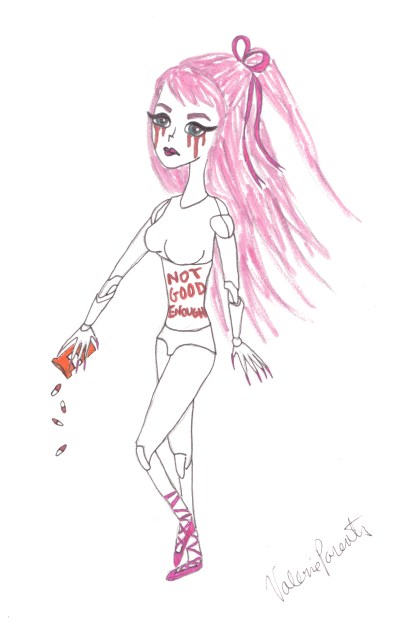
A Poetic Manifesto

A Poetic Manifesto by Valerie Parente

What it means to be an artist is that I take my life experiences and process them through a creative filter. My internal world manifests best through the art of written word. As a result, when I’m in pain I might write a “dark” piece. To those who find this work disturbing, this is my rebuttal.

"Scar Tissue"

I have every right to say anything I want to say
because this page is my stage and this is my brain
and the reason you felt uncomfortable when you read it
was because you have resonated with it.
If you become upset knowing that I am broken
then please understand that writing about my mental health
is how I begin to heal myself.

I will never stop emoting and hurting and healing and if any of this is problematic for someone then I pray you find the strength to learn how to be human one day.

– Valerie Parente (5-30-2019)

what is real?

My entire life has been me struggling to figure out what is real and what my OCD is tricking me into believing. I’m always trying to figure out if my feelings are just results of something fictitious I made up in my head or if these feelings are really there in the air. I just need you to own up to the truth because if you really did lead me to feel a certain way and choose to lie that I made it up in my head then that is literally the cruelest thing you could ever do to me.

Veronica

– Valerie Parente (5-10-2019)

“In Touch” by Valerie Parente

I have officially published my first full length fiction novel, “In Touch”!

In Touch by Valerie Parente (Book Jacket)

You can purchase “In Touch” by Valerie Parente on Amazon.com

Buy “In Touch” by Valerie Parente


“Undergraduate physics student, Jef Sterling, has done enough textbook reading to know that the universe is home to countless mind-blowing discoveries. But Jef never expected one of those discoveries to be the mind of an obsessive compulsive writer sharing the same campus as him. After reading a poem by Lacey Parker about her personal struggle with OCD, Jef’s highly rational brain fixates on uncovering the mysteries held captive in Lacey’s highly irrational brain. Throughout the course of a school year these two students exchange ideas that merge science with art, reality with fantasy, and physical phenomena with mental phenomena. While learning from one another Jef makes it his mission to make sense of Lacey’s nonsensical disorder and all of its incredible ironies; how she lives by the notion of feeling everything emotionally but dreads feeling anything physically, how her mind lives to protect as it gradually wreaks destruction, and most paradoxically how both Lacey’s most rewarding qualities and most detrimental flaws manifest from the same brain. In Touch by Valerie Parente is a realistic fiction novel alive with intellectual discussion, mental strife, heartache, and anecdotal insight into the cognitive confines of obsessive compulsive disorder.”

– Valerie Parente (8-5-2018)

Protection

One of the hardest notions for me to come to terms with in my tug-of-war with OCD is that you don’t need to be afraid to be protected. The intrusive thoughts make baseless threats, and entertaining them with your attention or compulsions only gives them artificial credibility. Peace of mind does not come from obsessing and the arduous resisting or amusing of OCD thoughts that might follow. Peace of mind comes from trust in the greater scheme of things and acceptance in what you cannot control.

– Valerie Parente (5-24-2018)

The Artist, The Muse: A Poetry & Prose Collection

The Artist, The Muse: A Poetry & Prose Collection by Valerie Parente OUT NOW

Buy THE ARTIST, THE MUSE Via Amazon

The Artist, The Muse is what you get when you interweave psychology, creativity, and spirituality into the poetic fabric of a mentally disordered daydreamer’s mind. Valerie Parente artfully hones the craft of written word in this collection of poetry and prose through fantastical metaphors, rhythmic patterns, heartfelt emotions, metaphysical references, and breath-taking epiphanies. Dark daydreams and silver-lining mantras blossom out of the obsessive compulsive writer’s verbal landscape as the artist becomes her own muse.

Includes poetry, prose, and artwork by Valerie Parente.

Table of Contents:

The Artist, The Muse
Conscience of Nonsense
Glitter In The Air
Shy of Me
The Gargoyle Mindset
An Inadequate Reflection
Ink
You’ve Made An Author Out Of Me
Essence
Grandiosity of the Sick
Daydreams Are Shadows
Sanctuary
Hindsight of the Falsehood
Echoes
Idu Ego
The Silver Screen
Realize These Butterflies
The Writer
Natural
The Instinct of Intuition
The Masterpiece Tragedy of Marionette
Egomaniac
Inquiries
Playing with Dolls
Imagination Is Not Free
Validation
I Wish You Well
Bleeding
Paradox Lock
Dreams of Floating
Give & Take
Her Bright Pink Shoes
Why I Apologize
My Heart Thaws
Mars
Sage of Tarkus
Normal
The Creeper
Young Sapling
Scarecrow
she could not master astral projection
Touch the Heart
Creator
To Be Human
Lady Luna and the Light Inside
Tiara
The Answer
Order In Disorder
Trust the Stars
Novelty
Message From The Universe

The Artist, The Muse by Valerie Parente

The Silver Screen

Bloom

The Silver Screen by Valerie Parente

My daydreams bloom from whatever prominent emotion I am feeling.

My daydreams seem to subconsciously and intuitively unravel themselves into ideal scenarios.
Like a movie the daydreams play out in a succession of mental frames on a cortical film reel. At best the mental fabrication distributes its duty between the two-track mind and I maintain my presence; above the absolute threshold I am in the audience and below the absolute threshold I am in the director’s chair. The dialogues between imaginary friends on the silver screen happen so instantaneously that the script’s origin teeters on the line between voluntary and involuntary awareness.

My daydreams are finalized by obsessive and repetitive hindsight.
When mentally reviewed these fantastic mental purges reveal subliminal truths. The loose reigns of control over the internal screenplays, regularly referred to as “imagination”, masquerade as intrusive images too appropriate and too satisfying to be resented.

– Valerie Parente (2-18-17)

The Daydreamer’s Inner Playwright

The tough part of being mindfully present when you are an introverted daydreamer is separating yourself as the existential human you are in reality aside from the inner playwright tinkering away within your brain. Daydreamers always have that anticipatory screenwriter designating mental energy, time, and focus onto future “could be” situations. The screenwriter’s role is to fantasize, modify, and mentally record dynamic imaginary scenarios onto the false memory film reel of the brain. They hone a future-oriented duty to wonder how events might transpire in the best possible way- “best” determined by an idealism based on multi-dimensional enlightenment from both profound and simple life lessons, not the same “best” seen as consecutive achievements of one-dimensional pleasurable experiences. Like any good book, the anticipatory daydreamer cares about writing your lifestory so that it conveys important messages and strikes as interesting.
But here’s where the dilemma arises. You are not an omniscient author of your lifestory. You cannot control or inherently understand the underlying workings of the external world, other people, and forces. You can only control and understand you.
To be grounded with your head in the clouds poses an impossible Schrödinger’s cat kind of dual state. A grounded, mindful person makes the most out of their experiences by coexisting with nature, observing and recognizing the sensations in the present. Meanwhile, a person with their head in the clouds is figuring out how to control and create nature- too busy being a superhuman scribe to be an affected character in the cosmic blueprint. Daydreamers are omniscient playwrights heedlessly attempting to define real people and real settings into character roles and plot lines. They are compelled to think up ways in which events will unfold, how Person A will come to meet Person B, and what the underlying motives for all parties involved might be… these are tasks no human being can do with their reality outside of penning a fictitious narrative on the sidelines.

With This Pen, I Thee Write
There is an anticipation in the daydreamer that can inappropriately bleed into the unfolding plain of the material world. This is not to say that anticipating life’s experiences is unhealthy- anticipation serves a very healthy purpose when used appropriately. You should anticipate your actions, reactions, and emotions, not those belonging to other people. There is a difference between anticipating how you will deal with given situations versus anticipating how the world will deal out situations. It is not your job to think up who you are going to meet at a certain setting or how people are going to feel about your choices. Leave the ‘how’ component to whatever omniscient forces dictate the universe. Focus on your current goal, focus on being the best you can be in this very moment, and do not focus on how every future person, place, or thing could play out in relevance to your goal until that person, place, or thing has stumbled its way into the reality of your present state. Daydreaming can be an exhilarating activity that can turn into worthwhile projects about alternate characters leading alternate lives, but daydreaming is not how you make the most of the life you are currently leading.

-Valerie Parente (10-29-16)

An Inadequate Reflection

An Inadequate Reflection by Valerie Parente

From the very core of her being she illuminated every room she walked in. In her healthiest state, her effervescent energy reflected onto all that she interacted with.
Perplexingly, as she entered a room whose walls were constructed from mirrors, she could not project her inner light onto the conspicuously ideal environment. The only radiation of light transcended from her optical form, emanating onto the boundaries boxing her in. As her being translated to the sleek canvases something equally underwhelming as it was uncanny occurred. The mirrors absorbed her energy. But this energy was not the energy that regularly brightened the moods of those around her. This shallow light was purged off of the metallic surface at the exact same angle from which it entered.
She virtually saw her own image, yet her demeanor seemed like an astral projection inconsistent of her true being. Her thriving frame of mind could not be captured by the hollow frame of mirror without warping the truth along a lateral axis. Her silhouette was inverted and her essential nature was unseen. In this limiting dungeon of a room she looked to the parallel world mounted on the walls and saw not a reflection of herself but a collection of perfectly stable atoms mocking the very imperfections that shaped her existential being. Those atoms fought to mimic a material vision, a vision far less reflective of her inner light than that of her fundamental spirit. And in a strangely empty place where a shining sheet was no more than an inherently dark plane, the optical illusion of a light-bearing presence existed.
At that moment she stopped relying on the mirror for gratification.

– Valerie Parente (10-12-16)

Quest

“You don’t want to get better.”
I was extremely offended.
“You don’t want to get better.”
I was extremely offended again.
“You don’t want to get better.”
…and again. It is difficult to get over an emotion when your glitching mind replays conversations… sentences… phrases… words… sounds… again, and again.
“You don’t want to get better.”
The sting of the comment was starting to subdue into a vapid memory, naturally losing its caustic power with every mental replay.
With a clearer mind I tried to understand why I was so offended by the comment.
“You don’t want to get better.”
That can’t be true. I know I want to get better. I know OCD is not my friend. But to entertain the idea that living with OCD is living carefree would be foolishly wrong. There is no serum to permanently reverse this mental illness in its totality, but even if there was, the idea of simply ousting obsessive compulsive disorder is not a matter of “getting better” to me. But why do I view “getting better” with such a cringe-worthy connotation?
It’s not that I want OCD… it’s that… I would feel lost without OCD.
At those critical ages when a kid becomes an adult, when virtues are established, and when identity is found, the development of my personality coincided with the development of my mental illness in a symbiotic relationship.
Obsessive, compulsive, and disordered have fused themselves with the evolution of my personality, so it makes perfect sense that I would feel lost without the anxiety disorder that has pervaded my growth into adulthood.
I do want to feel better. I do not want OCD to rule my life. But I understand that to embark on a life without this mental disorder (if I were somehow endowed with OCD’s cure) would be to face a whole new challenge in itself, a challenge of feeling totally lost and having to find myself. I would need to be ready to take on that challenge. But you know what? I don’t think I get to consciously choose when I’ll be ready for that challenge. And I know this to be true because I already unintentionally started to face that challenge of self-discovery. Because to realize there is a challenge that needs to be addressed is to already begin to address that challenge. I might be lost, but I will find my way.

"Rose Quest"

“Rose Quest” by Valerie Parente

– Valerie Parente (7-9-16)

Hierarchy of Aversions

Some obsessive compulsive disorder sufferers are deeply disturbed or repelled by certain objects, ideas, words, feelings… anything really. Often times people with OCD tend to perform avoidance rituals, in which they obsessively and compulsively avoid these things that stir up so much fear and anxiety. In my OCD struggle with avoidance rituals I have mentally deemed these repulsive obsessions my aversions.
In trying to sufficiently explain how my aversions rise and fall from different degrees of anxiety-inducing severity I have constructed a model I like to call my Hierarchy of Aversions.

Hierarchy of Aversions
NOTE: The Hierarchy of Aversions is constructed by an obsessive compulsive designer.
This mountain of obsessions was built on an OCD premise with the least worrisome aversions at the pinnacle and the most flagrant aversions at the foundation. While most hierarchical structures are stacked with the more dominant echelons ranking at the top of the pyramid, the Hierarchy of Aversions is layered with the least bothersome aversions at its peak, where they are closer to drifting out of sight and out of mind. Unorthodox, yes, but OCD is not orthodox, nor is it logical. Remember, the Hierarchy of Aversions consists of empirical levels that draw their order from a disorder in the constructor’s mind. The primary fears are set at the bottom of the pyramid because they bolster up every other fear. The obsessions that elicit compulsions on the bottom indirectly influence every fear on top.

NOTE: The Hierarchy of Aversions is constantly under renovation.
The contents at each level of the pyramid frequently climb up and down or come and go. What gives these OCD aversions mobility in the Hierarchy of Aversions is the mood of the constructor. Stress causes the disturbing images, ideas, or rituals to weigh heavier, subscribe to gravity, and drop closer to the bottom of the aversion pileup. When moods are lighter and stress is at bay it is common for aversions that once seemed so prominent and so debilitating to feel “not so bad after all”. They, too, become lighter and rise towards the top of the hierarchy. With a little push these flagrant obsessions can even float away.

NOTE: The Hierarchy of Aversions can be manipulated!
Sometimes aversions go away on their own, without the voluntary aid of OCD recovery. When an aversion seems to effortlessly evaporate it can feel like some random blessing. In trying to understand these “random blessing” cases I’ve come to the conclusion that there’s some subconscious effort on the obsessive compulsive disorder sufferer’s part, an effort that ironically involves using OCD to defeat OCD.
For me, when fears no longer appear fearful one of the two situations has typically happened…

1. I had an amazing experience relating to that aversion.
2. I had a horrible experience relating to that aversion.
These seem like very contradictory experiences. Illogical, right? That doesn’t matter. OCD does not rely on logic!

Allow me to explain with the following examples.
1. I had an amazing experience related to an aversion.
I used to have an intense anxiety-driven disdain of the number “7”. I would actively avoid touching, looking at, or talking about anything that had “7” written on it or generally pertained to this digit. But eventually one day, on the 7th, I had an amazing experience. I do not remember what the experience was (and it does not matter). The fact is, I now had a positive connotation to attribute to the number “7”. I almost felt like I had no choice but to graduate the aversion all the way up the Hierarchy of Aversions and, without a further thought, that aversion disintegrated into thin air. Relating “7” to something bad constituted this fear as an aversion in the first place, but using that same OCD mindset I related it to whatever “good” thing happened that day and wound up eliminating the aversion.
2. I had a horrible experience relating to an aversion.
Since the Hierarchy of Aversions is a structure of varying anxiety-inducing obsessions, the very order of this model comes from relating the severity of obsessions to one another. This can actually work to the OCD sufferer’s favor, because when a less severe aversion sitting towards the top half of the Hierarchy suffices, it is much easier to quickly overcome that obsession, or at least diminish the anxiety it induces, by comparing that obsession to the more intense obsessions at the hierarchy’s base.
I actively try to avoid germs, so I do not like walking barefoot in my own home. But even more so I avoid walking barefoot in any environment outside of my home. So, in the instance that I am forced to walk across my floor barefoot because I forgot socks or shoes I get anxious, but then I remind myself that it could be worse- I could be walking across the floor of some filthy public setting. And even though the alleviation of that anxiety is temporary, it is still alleviation. And yes, I am still averted to walking on the floor barefoot, but in pair with exposure this comparison of “it could be worse” nudges that aversion up higher on the hierarchy where it is not nearly as bad as it once seemed.

These two methods I have used to graduate aversions from firm obsessions to fleeting memories involve controlling the OCD with OCD. There is no getting rid of this disease for me, just manipulating it to my advantage so that certain obsessions and fears seem less scary and become more prone to evaporating.

– Valerie Parente (6-26-16)